Building muscle from 60 without a gym is possible with a chair, a wall, and your own body weight—three times a week is enough. The 8-week plan first increases repetitions, then sets, with at least 48 hours of rest between sessions. Good technique and consistency are key, not the number of exercises.
From around age 30, the body gradually loses muscle mass without stimulation.
Start with 2 sets of 8–10 repetitions at a steady pace.
Train two to three times a week, with at least 48 hours of rest between sessions.
Only move on to the next block when you can complete all sets with good form.
Record your repetitions and rate your effort from 1 to 5 after each session.
Why building muscle from 60 without a gym works so well
Building muscle from 60 without a gym works because the strongest stimulus for your muscles doesn't come from machines, but from good technique, consistency, and a workload that fits your daily life.
Strength training at home from 60 is effective because you can fit it into your own rhythm. No waiting for a free machine, no locker room, no lost half-hour commute.
The most important point upfront: Your progress comes not from more exercises, but from more repetitions with better control. That is exactly what the plan in this article is based on.
Understanding muscle loss from 60: What changes and what you can do about it
From around age 30, the body gradually loses muscle mass if it receives no stimulus. By 60, this process is often noticeable: climbing stairs becomes more strenuous, carrying groceries becomes harder, and stability seems reduced. Experts refer to sarcopenia, the age-related loss of muscle mass and strength.
What you can do about it is encouragingly concrete:
Provide stimulus: Muscles are only maintained if they have to work regularly.
Ensure protein intake: Without sufficient protein, the muscles lack the building material.
Use everyday life: Every trip to the stairs instead of the elevator is a training stimulus.
One point that many guides omit: Muscle building and recovery are two halves of the same process. How this works together for endurance athletes over 50, we explore in our guide to sports nutrition for marathon runners over 50. And if you want to understand how nutrition supports recovery on a plant-based diet, you will find the basics in the post on vegan nutrition and recovery.
Strength training at home from 60: Starting safely and clarifying health requirements
Strength training at home from 60 starts most safely with a brief assessment before you do the first exercise. Check whether your cardiovascular system and joints can handle the strain. If you have pre-existing conditions, have had surgery, or have unclear symptoms, a medical check-up is necessary before you start training.
Medical clearance for heart, vascular, or joint problems
A clear area of about two square meters, non-slip floor
A stable chair without wheels, a wall for support
Water within reach, comfortable shoes or sneakers
Fixed training times in the calendar, at least twice a week
Important for warming up: Five minutes of light movement, such as marching in place and arm circles, prepares the joints and muscles. Starting cold is the most common mistake we see.
Muscle building in older age training plan: The progressive 8-week plan for home
The following training plan for building muscle in older age increases the workload in two stages: first more repetitions, then more sets. Train three days a week, for example Monday, Wednesday, and Friday, and keep at least 48 hours of rest between sessions.
Determine your starting level
Before you start week 1, test each exercise once with 8 repetitions. If you can do 8 with good form and without pain, that is your starting weight or starting variation. If not, take the easier variation (more wall contact, smaller bottle, half depth). Record for each exercise: variation, repetitions, how difficult it felt (easy / medium / difficult).
The 8-week plan in detail
Week
Sets per exercise
Repetitions
Rest between sets
Focus
1-2
2
8-10
90 sec.
Learn technique, steady pace
3-4
2
12-15
75 sec.
More repetitions, clean execution
5-6
3
10-12
60 sec.
More sets, same exercises
7-8
3
12-15
60 sec.
Maintain workload, ensure quality
Progression rule: Only move to the next block when you can complete all sets in the upper repetition range with good form in the last week of a block. If you cannot, repeat the week once. This is not a step backward, but the actual training stimulus.
The exercises per week
Each session contains the same six basic exercises so you can compare technique and progress:
Wall-supported lunges - 2-3 sets per side, knee stays behind the toes.
Wall push-ups - 2-3 sets, body forms a line.
Water bottle rows - 2-3 sets per arm, elbows close to the body.
Glute bridges - 2-3 sets, hold for 2 seconds at the top.
Bird-dog on all fours - 2-3 sets per side, slow and controlled.
What a specific session looks like
Warm up for five minutes (marching in place, arm circles, hip circles).
Chair squats - 2 sets.
Wall push-ups - 2 sets.
Water bottle rows - 2 sets per arm.
Wall-supported lunges - 2 sets per side.
Glute bridges - 2 sets.
Bird-dog - 2 sets per side.
Cool down and stretch for five minutes.
Take the rest period from the table between sets. Between exercises, 30 to 60 seconds is enough to get into the next position.
Weekly structure and recovery
Monday: Session A (all six exercises).
Wednesday: Session B (all six exercises, order slightly changed).
Friday: Session C (all six exercises, focus on good technique).
Tuesday, Thursday, weekend: Walking, everyday movement, no strength stimulus.
If you have severe muscle soreness for two days after a session, the workload was too high. Stay at the same level for one week and only increase after that.
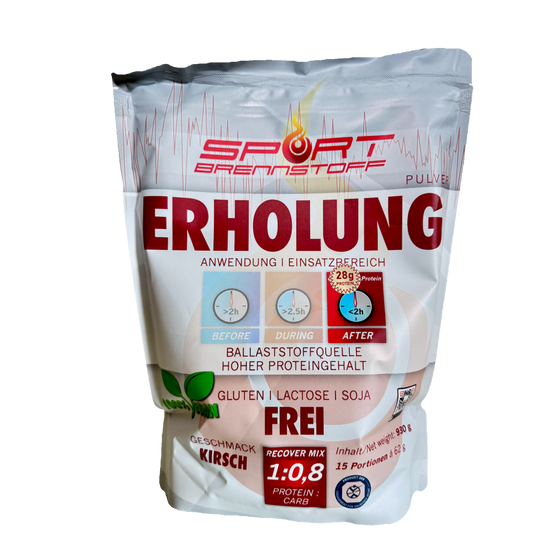
After the session, the vegan Cherry Recovery Shake supports you with plant-based protein and carbohydrates in one drink.
Strength training from 60: How often you should train
Strength training from 60: how often? Twice a week is the minimum, three times a week brings more progress, as long as you stick to the recovery days. What matters is not the number of sessions, but whether you stick with them for months.
This distribution has proven effective:
Two sessions per week: Full-body training, ideal for getting started.
Three sessions per week: Full-body with changing focuses.
Four sessions per week: only with experience and good technique.
There should be at least 48 hours between two sessions for the same muscle group. Training too often slows down muscle building. One last point that many underestimate: sleep and protein intake determine how well you handle the next session.
The 15-minute workout from 60 for busy schedules
A 15-minute workout from 60 is not a compromise, but a strategy. Short, regular sessions beat a long session that you end up skipping. For busy schedules, this is often the only way to stick with it.
The sequence in three blocks:
Minutes 1-3: Warm up, marching in place, arm circles.
Minutes 4-11: Four exercises in rotation, 40 seconds of work, 20 seconds of rest each: chair squats, wall push-ups, glute bridges, water bottle rows.
Minutes 12-15: Cool down, gentle stretching for legs and back.
Two rounds are enough. Do the workout two to three days a week and increase repetitions first, not the pace. For recovery afterwards: fluids and protein are essential.
Exercises for the whole body: Legs, back, upper body, and core
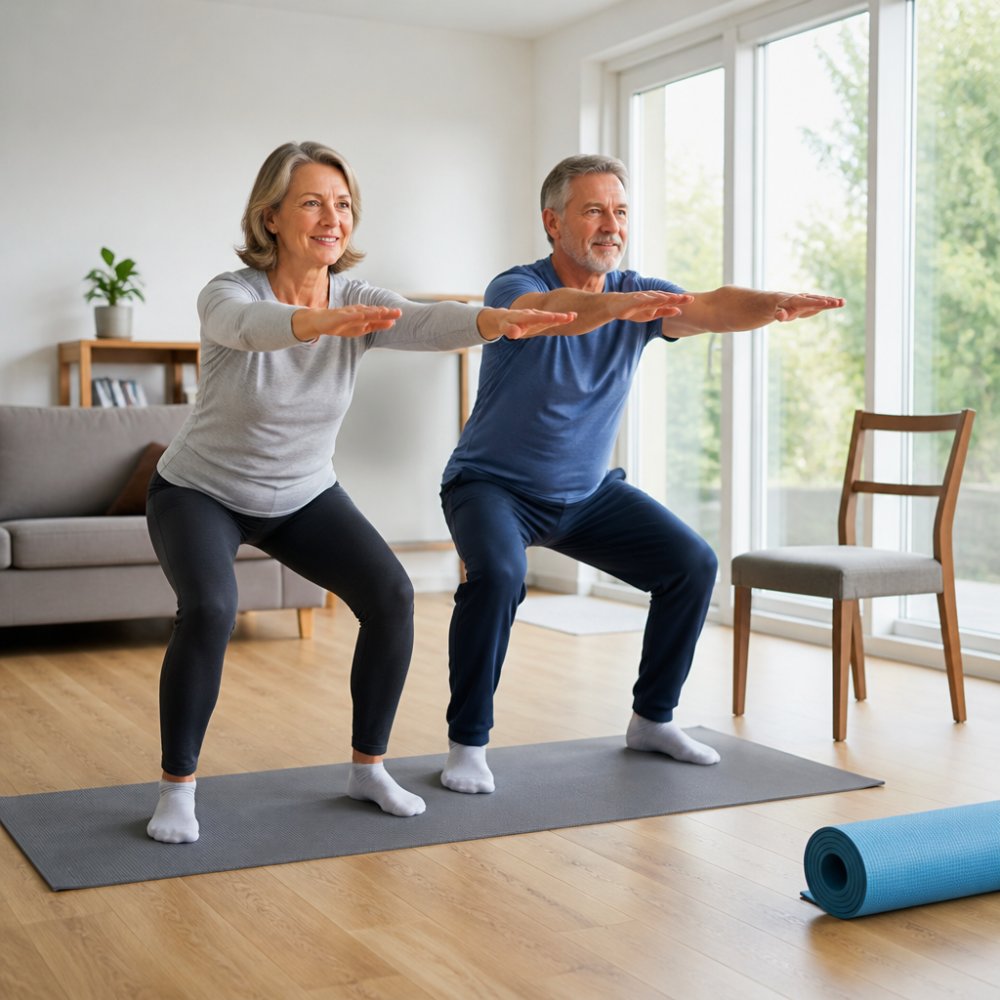
A woman and a man around 60 in comfortable sportswear are doing squats on an exercise mat in a bright living room, with a yoga mat and a chair ready, and daylight coming through large windows
A full-body workout from age 60 covers four areas: legs, back, upper body, and core. These exercises require no equipment and can be performed safely at home.
Legs and glutes: Chair squats, lunges with wall contact, hip raises.
Back: Rows with a water bottle or dumbbell, bird-dog on all fours.
Upper body and arms: Wall push-ups, then push-ups on a chair.
Core and midsection: Forearm plank, wall side plank.
For every exercise, focus on a steady pace and full control. Keep your abs lightly engaged and continue breathing. If an exercise cannot be performed properly, choose the easier version instead of skipping it.
Exercise variations for pain, limited mobility, and using household items
With pain or limited mobility, the variation determines success, not giving up. Adapt the exercise instead of cutting it. This is the part most instructions leave out.
Knee problems: Squats only halfway down, replace lunges with hip raises.
Shoulder problems: Wall push-ups instead of floor push-ups, rows with a smaller range of motion.
Back problems: Replace forearm plank with hip raises, perform bird-dog slowly.
Balance problems: All exercises standing with wall contact or a chair edge.
Household items help you get more resistance: water bottles as weights, a backpack with books for the legs, a towel for stretching. Warning: If you experience sharp pain, dizziness, or shortness of breath, stop the exercise immediately and have the cause checked instead of continuing to train.
How to measure your progress and adapt the training
Progress is not only shown on the scale. Measure it by things you feel in everyday life and by numbers you record during training. This is exactly where a plan that works separates from one that only exists on paper.
The simple training log
Keep a notebook or a table with five columns. Record one line after each session:
Date
Exercise
Variation
Reps (clean)
Feeling (1-5)
04.11.
Chair squats
Chair, half depth
10 / 10
3
04.11.
Wall push-ups
Wall, feet close
8 / 8
2
Rate the feeling from 1 (very easy) to 5 (very difficult). Anything above 4 means: resistance is too high, make the next session easier. Anything below 2 means: resistance is too low, increase the next session.
Four measurable progress criteria
Reps: If you can perform the upper number of reps cleanly in one exercise for two sessions in a row, increase the resistance.
Tempo: If you lower the movement over three seconds without losing control, that is progress—even without more reps.
Rest time: If you shorten the break between two sets by 15 seconds and perform the same number of reps, you have improved.
Everyday function: Once a week, note three things: How many stair steps can you manage without a break? How long can you stand without support? How easy is it to get up from a chair? These are your real success criteria.
Adjustment rules - when to change what
More reps: From 10 to 12 to 15 before doing more sets.
Slower tempo: Lower over three seconds instead of one.
Shorter breaks: Shorten from 90 to 60 seconds.
More resistance: Heavier bottle, fuller backpack, or a more difficult variation (e.g., push-ups from a chair instead of the wall).
Step back: If you record a feeling of 5 for two sessions in a row or experience pain, go back one step. This is not failure, but management.
The 4-week check
Every four weeks, take 10 minutes to compare the first line with the last line of each exercise. Ask yourself:
Can I do more clean reps than four weeks ago?
Does the same exercise feel easier?
Has an everyday function improved (stairs, carrying, getting up)?
If you answer yes to two of these three questions, you are on track. If not, first check recovery (sleep, breaks, hydration) and only then the training load. This management is the core of an individual training plan—and the reason why a plan without a log quickly becomes a dead end.
Frequently Asked Questions
How long does muscle building take at age 60?
Initial strength gains are often noticeable after four to six weeks of regular training, while visible changes usually take three to six months. Consistency and gradually increasing resistance are crucial: at least twice a week, with 48 hours of rest between sessions. Additionally, paying attention to sufficient protein and recovery further supports muscle building at home from age 60.
How often should you do strength training from age 60?
For beginners, two to three full-body sessions per week are ideal, with at least one rest day in between. Your body needs around 48 hours to adapt to the resistance. Start with two sessions and only increase to three after four to six weeks. This keeps strength training at home sustainable from age 60 and helps you avoid overtraining.
Which exercises are suitable for home from age 60?
Proven no-equipment exercises include squats to a chair, lunges with support, wall push-ups or push-ups on a table edge, rows with a resistance band, and forearm planks. They train the legs, back, upper body, and core simultaneously. Choose variations that feel safe, and increase reps or hold time before switching to more difficult variations.
How can you start training safely from age 60?
First, check with your doctor whether there are any health restrictions, and start with short sessions of 10 to 15 minutes. Warm up for five minutes, focus on controlled movements, and avoid exercises that cause pain. A 15-minute bodyweight workout from age 60 is a good start. Gradually increase the volume and intensity over several weeks.
Hat einen angenehmen neutralen Geschmack und geht direkt in die Beine! Nutze es in fast jedem Training für meinen Ironman 👍
Hallo Melanie, vielen Dank für deine tolle Rückmeldung! Schön, dass dir der neutrale Geschmack gefällt und dich unser Sportgetränk bei deinen Ironman-Trainings unterstützt. Wir wünschen dir weiterhin viel Erfolg und starke Beine! :-)
Das Wettkampf-Sportgetränk hat meine Erwartungen voll erfüllt
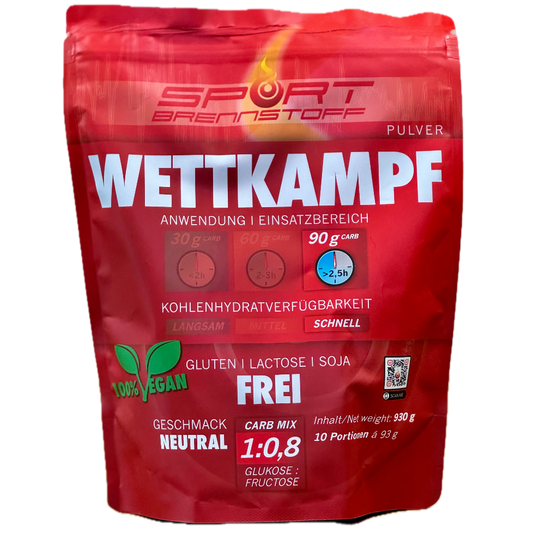
Das Wettkampf-Sportgetränk hat meine Erwartungen voll erfüllt. Über die gesamte Zeit des Radfahrens (Langdistanz) konnte ich das Getränk zuführen und kam ohne spürbares Energiedefizit in T2 an.
Angenehmer, nicht aufdringlicher oder vordergründiger Geschmack.
Hallo Jens, vielen Dank für deine tolle Rückmeldung! Schön, dass dich das Sportgetränk auf deiner Langdistanz zuverlässig versorgt hat und dir der angenehme, dezente Geschmack gefällt. Wir wünschen dir weiterhin viel Erfolg bei deinen Wettkämpfen! Ingolf
Mit diesen beiden Produkten kommt man wirklich in der Aufbauphase sehr gut klar
Mit diesen beiden Produkten kommt man wirklich in der Aufbauphase sehr gut klar.
Hallo Daniel, danke für dein tolles Feedback! Es freut uns sehr, dass das Basispaket dir in der Aufbauphase so gut hilft. Viel Erfolg weiterhin beim Training!
Tatsächlich ist das 6 Tage in der Woche beim Frühstück dabei
Tatsächlich ist das 6 Tage in der Woche beim Frühstück dabei. Innerhalb von einer halben Stunde ist meine Energie geladen und kann direkt ins Training einsteigen. Noch nie Probleme beide Verdauung
Hallo Daniel, vielen Dank für deine tolle Rückmeldung! Es freut uns sehr, dass das Sportgetränk dich so zuverlässig beim Frühstück und beim Start ins Training unterstützt – und du es gut verträgst. Weiterhin viel Freude beim Training! Ingolf
Super Preis Leistungsverhältnis, wir setzen es zum Muskelaufbau und zur Regeneration ein . Wir sind seit vier Monaten sehr erfolgreich mit diesem Produkten.
Hallo Daniel, vielen Dank für deine positive Rückmeldung! Es freut uns sehr zu hören, dass du mit unserem Recovery Shake so erfolgreich bist. Viel Erfolg weiterhin beim Muskelaufbau und der Regeneration! Dein Team von Sportbrennstoff