Individualized sports nutrition advice for ambitious cyclists
Last updated: October 29, 2026
Quick overview
Individual sports nutrition advice for ambitious cyclists adapts energy intake, carbohydrates, and fluids to training data, everyday life, and competition goals. At SportBrennstoff, it begins with a questionnaire about your basic parameters, whose information is evaluated before the conversation. In the conversation, we discuss the starting situation, experiences, and goals and derive initial recommendations.
Three hours before the competition, easily digestible carbohydrates with little fiber are suitable, such as white rice or oatmeal with a banana.
For easy base training over 1 to 3 hours, 30 to 60 g of carbohydrates per hour is in the orientation range.
For long rides and stages from 3 hours, 80 to 120 g per hour is only reasonable with a trained stomach.
Never increase the carbohydrate amount at the same time as the intensity, first the tolerance, then the load.
The individual conversation on sports nutrition lasts 30 minutes, the initial conversation with the questionnaire 45 minutes.
Why individual sports nutrition advice for ambitious cyclists makes the difference
Individual sports nutrition advice for ambitious cyclists is the targeted adjustment of energy intake, carbohydrates, and fluids to training data, everyday life, and competition goals. At SportBrennstoff, we rely on a concept that was developed by athletes for athletes.
Many cyclists train hard and still miss the mark. A standard plan from the internet knows neither your training volume nor your gastrointestinal tolerance.
[Cyclist on a road bike during a long ride in hilly landscape, morning light, concentrated look | section:Why individual sports nutrition advice for ambitious cyclists makes the difference]
What to eat 3 hours before the competition: The last building block before the start
Three hours before the competition, a meal with easily digestible carbohydrates and little fiber is suitable. It fills the glycogen stores without straining the stomach. Suitable are, for example:
White rice with a little salt
Pasta with lean tomato sauce
Oatmeal with a banana
White bread with honey
Keep fat and protein low. They slow down digestion. Test every meal beforehand in training, not on race day.
Carbohydrates in cycling: How much per hour is really reasonable
Carbohydrate intake in cycling is not a fixed number, but a value that results from intensity, duration, and training goal. A rough orientation for ambitious cyclists:
Exercise
Typical duration
Carbohydrates per hour
Easy base training
1-3 h
30-60 g
Tempo/threshold work
1-2 h
60-90 g
Long ride, competition
3 h+
80-120 g (only with a trained stomach)
Short, intense race
under 1 h
often no intake needed, mouth rinsing possible
These ranges are not a guarantee, but starting points. The actual requirement depends on your body weight, your pace, the outside temperature, and your individual tolerance.
Why the source is more important than the quantity
The intestine absorbs carbohydrates in two ways: glucose via the sodium-glucose transporter SGLT1, fructose via GLUT5. Both ways are limited.
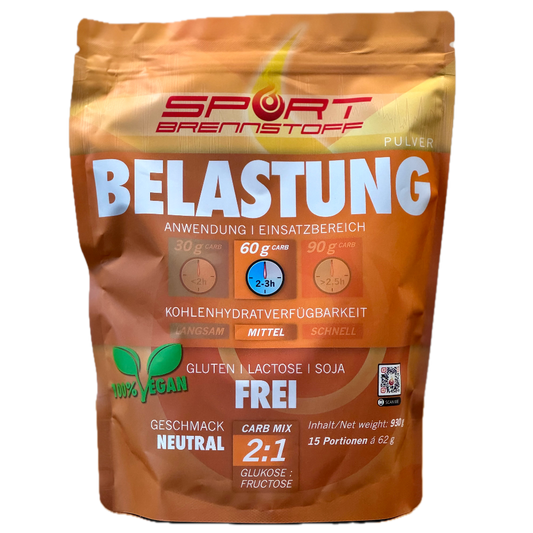
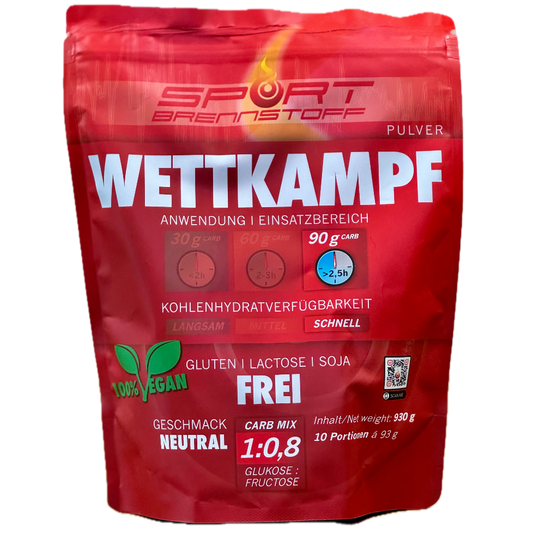
A ratio of 2:1 (glucose to fructose) is suitable for medium amounts, 1:0.8 for very high intakes. SportBrennstoff BELASTUNG delivers 60 g per serving in the 2:1 ratio, WETTKAMPF 90 g in the 1:0.8 ratio. But one serving is not automatically your hourly requirement - divide it over the planned session.
Periodization: not the same amount every day
A coupling of carbohydrate intake to the training stimulus is frequently discussed:
The amount must be trained
A gradual increase of the carbohydrate amount in training can help improve tolerance. Who skips this step can expect discomfort on race day.
Pro tipTest every new carbohydrate amount first on an easy ride, not in a key session and never on race day.
Nutrition on long bike rides: Energy, fluids, and gastrointestinal tolerance
On long bike rides, a regular intake of small carbohydrate portions can be an option that the stomach often tolerates well. You can dive deeper into the Guide to vegan sports nutrition for long bike rides.
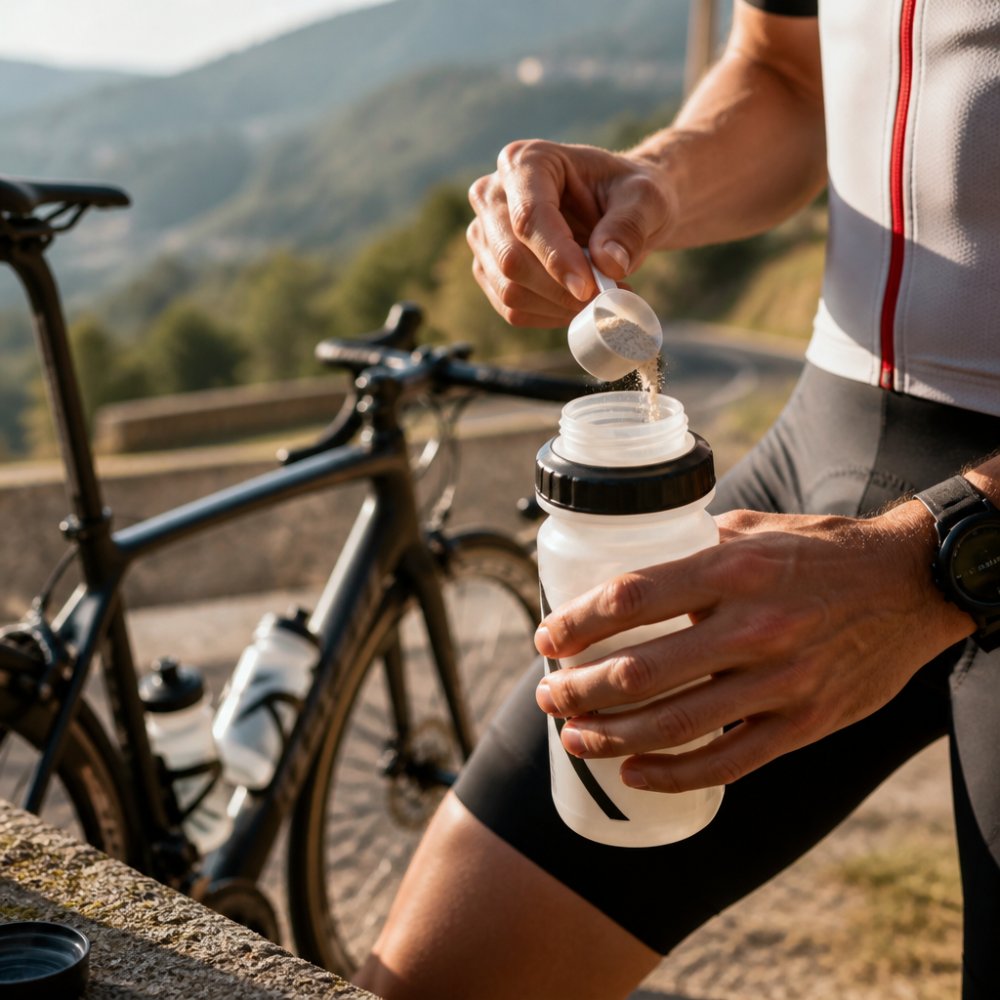
Road cyclist mixing sports drink powder into a water bottle on the roadside for the long ride
Fluids and sodium
Fluid requirement is individual and fluctuates with temperature, intensity, and sweat rate. Who sweats heavily also loses sodium with the sweat, and a sports drink with electrolytes can then be an option (the WHO).
Gastrointestinal discomfort can arise, among other things, from too concentrated drinks, large portions at once, or an unusual amount on race day. Concrete tips to avoid stomach problems at triathlon competitions can be found in the linked article. A possible procedure:
Week 1-2: a familiar carbohydrate amount per hour, only with a drink.
Week 3-4: the same amount, additionally a small portion of a bar or gel.
Week 5-6: increase the amount by 10-20 g per hour, still in training.
Before the competition: test the planned race strategy at least twice in a long ride.
AttentionNever increase the carbohydrate amount at the same time as the intensity. First the tolerance, then the load.
Strategy by distance
Medium distances (1-3 h): 60-90 g per hour, combined with fluids; gel or bar in small portions.
Long rides and stages (3 h+): 80-120 g per hour, only with a trained stomach; alternate solid and liquid sources to avoid taste fatigue.
Sports nutrition for cyclists compared: What you look for when choosing
When comparing sports nutrition for cyclists, four points count: carbohydrate amount per serving, sugar ratio, tolerance, and certification. What you must look for regarding doping-free sports nutrition can be read in the linked article. Look for clear information instead of advertising promises.
Process of individual advice: From assessment to nutrition plan
An individual advice starts with an assessment. At SportBrennstoff, you fill out a questionnaire about your basic parameters beforehand. Your information is evaluated before the conversation.
In the conversation, we discuss your starting situation, previous experiences, and goals. After that, we assess your basal metabolic rate and give initial recommendations. At the end, we agree on the next steps.
This is how the process looks:
Fill out questionnaire
Have information evaluated
Discuss goals and experiences
Assess basic parameters
Derive initial recommendations
Determine next steps
A nutrition plan with a food diary is not part of the initial conversation. If you want more support, this can be discussed individually.
Your next step: Book an initial conversation or individual conversation at SportBrennstoff
Do you have concrete questions about nutrition in training or competition? Then the individual conversation on sports nutrition for €35 is the targeted entry. 30 minutes, your questions, clear next steps.
Do you first want a structured overview of your starting situation? Then book the initial conversation with questionnaire for €60. 45 minutes, evaluated questionnaire, initial recommendations.
Nutrition consultation: Initial consultation with questionnaire – 45 minutes
Both consultations are conducted via an integrated calendar. You choose the time that suits your training.
Frequently Asked Questions
What do cyclists eat 3 hours before a race?
Three hours before the start, the last substantial meal should be easy to digest and primarily provide carbohydrates, such as rice, pasta, or oatmeal with little fat and fiber. This leaves enough time for digestion without straining the stomach. Test this meal beforehand during training so that you experience no surprises on race day. Individual sports nutrition advice for ambitious cyclists can adapt the portion size to your energy needs.
How many carbohydrates should you consume per hour when cycling?
For longer, intense sessions, many cyclists plan 60 to 90 grams of carbohydrates per hour, depending on tolerance and training status. Products with a glucose-fructose ratio such as SportBrennstoff BELASTUNG (60 g per serving) or WETTKAMPF (90 g per serving) support this intake. It is important to test the amount gradually during training and not introduce it for the first time on race day.
How often should you refuel during a long bike ride?
For rides lasting over two hours, it is recommended to consume small amounts regularly rather than a lot at once after long intervals. A rhythm of one serving of a drink or bar approximately every 20 to 30 minutes can be an option. This keeps energy intake stable and prevents the stomach from becoming overloaded. Plan your nutrition before the ride and test it at different intensities.
What is the best way to test race nutrition during training?
Start with a familiar foundation and gradually introduce new products or larger quantities during easy sessions. Increase the intake over several weeks until you can easily tolerate the planned race quantity. Note down what you ate and drank and when to identify patterns. This way, you can rely on a proven strategy on race day and avoid stomach problems.
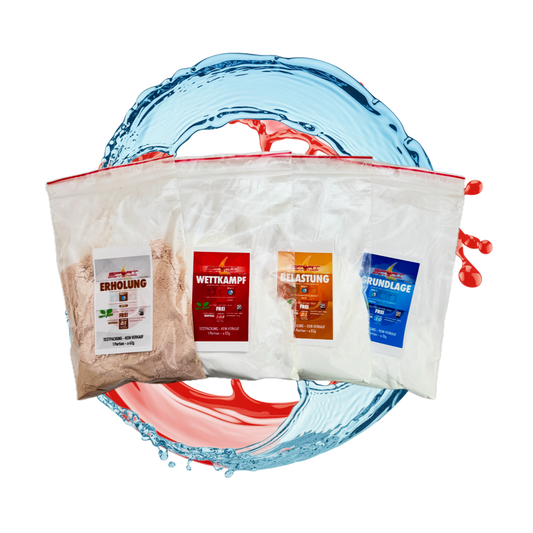
The difference between a good and a great race day often lies in nutrition. Test your nutrition during training, not in a race. SportBrennstoff supports you with vegan, stomach-friendly products and individual dosage recommendations based on your training intensity. Start with the €5 trial package and find out what suits you.
SportBrennstoff BELASTUNG – Sports drink with 60 g of carbohydrates
Hat einen angenehmen neutralen Geschmack und geht direkt in die Beine! Nutze es in fast jedem Training für meinen Ironman 👍
Hallo Melanie, vielen Dank für deine tolle Rückmeldung! Schön, dass dir der neutrale Geschmack gefällt und dich unser Sportgetränk bei deinen Ironman-Trainings unterstützt. Wir wünschen dir weiterhin viel Erfolg und starke Beine! :-)
Das Wettkampf-Sportgetränk hat meine Erwartungen voll erfüllt
Das Wettkampf-Sportgetränk hat meine Erwartungen voll erfüllt. Über die gesamte Zeit des Radfahrens (Langdistanz) konnte ich das Getränk zuführen und kam ohne spürbares Energiedefizit in T2 an.
Angenehmer, nicht aufdringlicher oder vordergründiger Geschmack.
Hallo Jens, vielen Dank für deine tolle Rückmeldung! Schön, dass dich das Sportgetränk auf deiner Langdistanz zuverlässig versorgt hat und dir der angenehme, dezente Geschmack gefällt. Wir wünschen dir weiterhin viel Erfolg bei deinen Wettkämpfen! Ingolf
Mit diesen beiden Produkten kommt man wirklich in der Aufbauphase sehr gut klar
Mit diesen beiden Produkten kommt man wirklich in der Aufbauphase sehr gut klar.
Hallo Daniel, danke für dein tolles Feedback! Es freut uns sehr, dass das Basispaket dir in der Aufbauphase so gut hilft. Viel Erfolg weiterhin beim Training!
Tatsächlich ist das 6 Tage in der Woche beim Frühstück dabei
Tatsächlich ist das 6 Tage in der Woche beim Frühstück dabei. Innerhalb von einer halben Stunde ist meine Energie geladen und kann direkt ins Training einsteigen. Noch nie Probleme beide Verdauung
Hallo Daniel, vielen Dank für deine tolle Rückmeldung! Es freut uns sehr, dass das Sportgetränk dich so zuverlässig beim Frühstück und beim Start ins Training unterstützt – und du es gut verträgst. Weiterhin viel Freude beim Training! Ingolf
Super Preis Leistungsverhältnis, wir setzen es zum Muskelaufbau und zur Regeneration ein . Wir sind seit vier Monaten sehr erfolgreich mit diesem Produkten.
Hallo Daniel, vielen Dank für deine positive Rückmeldung! Es freut uns sehr zu hören, dass du mit unserem Recovery Shake so erfolgreich bist. Viel Erfolg weiterhin beim Muskelaufbau und der Regeneration! Dein Team von Sportbrennstoff