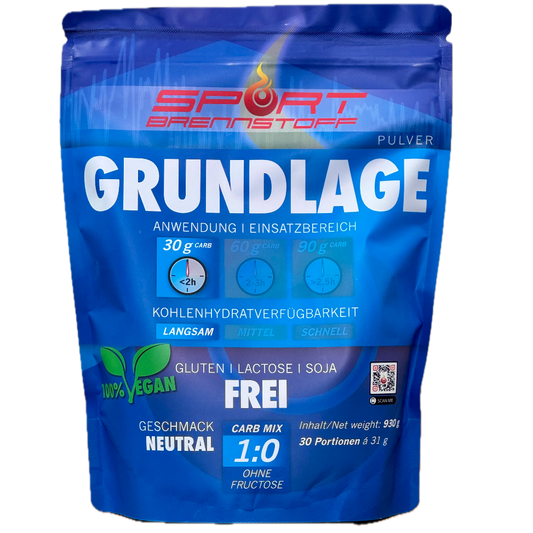
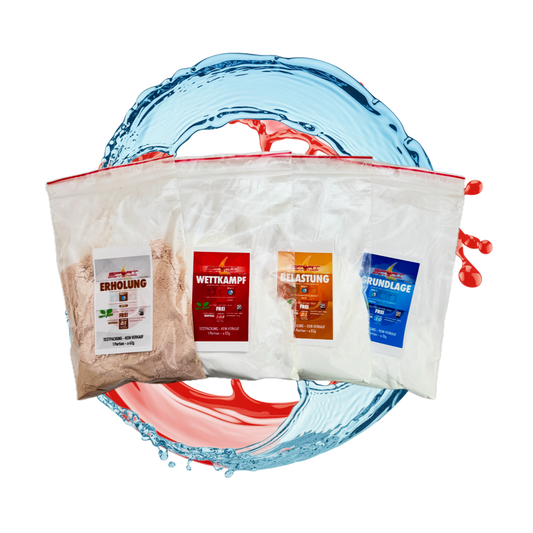
The 3 best vegan electrolytes for endurance athletes are SportBrennstoff GRUNDLAGE with up to 30 g of carbohydrates per hour for easy sessions, BELASTUNG with 60 g of carbohydrates for intense training, and WETTKAMPF with 90 g of carbohydrates for competitions and long endurance. All three products are vegan, gluten-free, and lactose-free.
GRUNDLAGE uses isomaltulose for stable blood sugar levels and gentle stomach support during Zone 2 training.
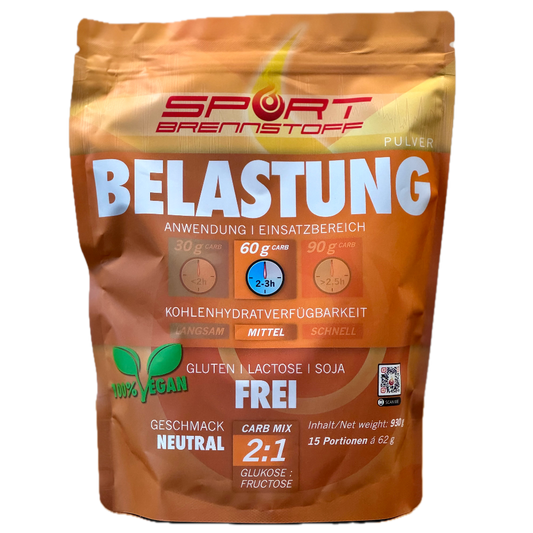
BELASTUNG offers a 2:1 glucose-fructose ratio for optimized energy absorption during intense training.
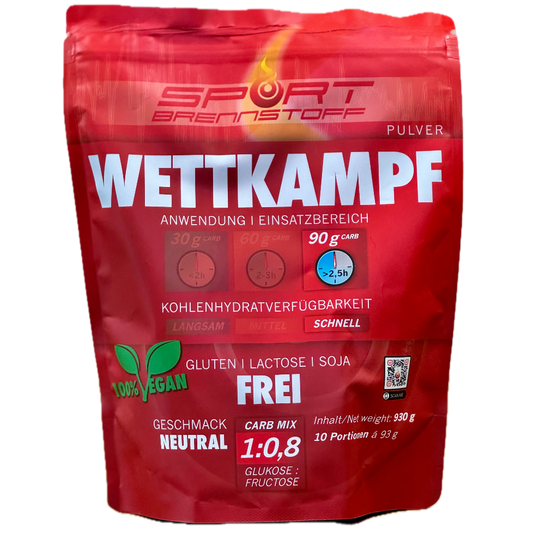
WETTKAMPF with a 1:0.8 ratio enables maximum carbohydrate absorption over three hours in competition.
You determine your sweat rate by weighing yourself before and after a training session without fluid intake.
Electrolyte drinks for runners and endurance sports: Why minerals are crucial
Anyone who runs, cycles, or swims for more than 60 minutes loses not only water through sweat, but also sodium, potassium, and other minerals.
At SportBrennstoff, we develop the 3 best vegan electrolytes for endurance athletes specifically for different training intensities. Our vegan products combine scientifically sound mineral mixtures with carbohydrates - precisely tailored to the exertion your body experiences. The result: optimized energy supply, support of active regeneration, and improved performance through scientifically sound nutrition.
The key lies in the right balance. Too little sodium can lead to dehydration, too much can cause stomach problems.
Comparison: The 3 best vegan electrolyte powders at a glance
The 3 best vegan electrolytes for endurance athletes differ not only in the amount of carbohydrates, but also in the sodium intake, the electrolyte ratio, and the price per serving. Exactly these three values determine in training whether a drink is right for your exertion. The following overview presents them transparently side by side - with the information provided on the packaging and in the product data.
Comparison table: Carbohydrates, sodium, and price per serving
Product
Carbohydrates per serving
Glucose-fructose ratio
Sodium source
Vegan suitability
Best use
Package contents
Price per package
Price per serving
GRUNDLAGE
up to 30 g/h
Isomaltulose (Palatinose™)
Sodium chloride
yes, purely plant-based ingredients
Zone 2 training, easy sessions
1 bag
€36.00
depending on the dosage per hour
BELASTUNG
60 g (750 ml)
2:1
Sodium chloride
yes, purely plant-based ingredients
Intense training, intervals
15 standard servings
€30.00
approx. €2.00 per standard serving
WETTKAMPF
90 g (750 ml)
1:0.8
Sodium chloride
yes, purely plant-based ingredients
Competition, long endurance
10 standard servings
€30.00
approx. €3.00 per standard serving
Note: The price per serving is calculated by dividing the package price by the number of standard servings. For GRUNDLAGE, the price per serving depends on the individually dosed amount per hour.
What the table reveals about the products
Sodium content and electrolyte ratio: All three products use sodium chloride as a source of sodium. This is deliberately chosen because sodium chloride makes the sodium content easy to dose and can be stably processed in powder form. For endurance athletes, sodium is the central electrolyte because it is lost in high concentrations through sweat. The exact amount of sodium per serving is stated on the respective packaging - compare it with your sweat rate, not just with the label of another manufacturer.
Carbohydrate amount as a distinguishing feature: GRUNDLAGE provides up to 30 g of carbohydrates per hour and is thus designed for easy sessions. BELASTUNG provides 60 g per standard serving, WETTKAMPF 90 g. The gradation follows the training duration and intensity, not the taste.
Vegan suitability: All three products are vegan, gluten-free, lactose-free, and soy-free. When comparing with other manufacturers, pay attention to the complete list of ingredients - terms like "whey", "lactose", or "honey" exclude vegan suitability. SportBrennstoff fully declares the ingredients, so you can trace the plant-based origin.
Price per serving: BELASTUNG is around €2.00 per standard serving, WETTKAMPF around €3.00. GRUNDLAGE cannot be calculated generally per serving because the dosage per hour varies.
Quick conclusion for product selection
GRUNDLAGE is the most affordable entry option for easy sessions and sensitive stomachs.
BELASTUNG offers the best ratio of carbohydrate amount and price per serving for intense training.
WETTKAMPF is the choice for competitions and long endurance, where maximum carbohydrate intake counts - the higher price per serving is due to the higher concentration.
SportBrennstoff GRUNDLAGE: Electrolyte powder for endurance sports in the base range
For easy training sessions, you do not need the maximum amount of carbohydrates. SportBrennstoff GRUNDLAGE relies on isomaltulose (Palatinose™) as a carbohydrate source - a slower type of sugar that keeps blood sugar more stable and is gentle on the stomach lining.
The product provides up to 30 grams of carbohydrates per hour, which is completely sufficient for Zone 2 training.
GRUNDLAGE is perfect for training sessions up to 90 minutes in the aerobic range. Many runners and cyclists underestimate how important mineral intake is even at moderate pace - even those who sweat lightly still lose sodium.
SportBrennstoff BELASTUNG: Intense training with an optimized glucose-fructose ratio
When the intensity increases - during interval training, longer bike rides, or fast running sessions - your body needs more energy.
Why this ratio? Glucose and fructose use different transporters in the intestine. The 2:1 ratio maximizes the absorption amount and prevents one type of sugar from overloading the intestine.
A standard serving contains 15 standard servings per bag, which gives you flexibility in dosage.
Vegan, gluten-free, lactose-free, and soy-free - the product suits various diets and intolerances.
SportBrennstoff WETTKAMPF: Maximum carbohydrates and sodium in the sports drink
For competition days and long endurance sessions over 90 minutes, you need maximum energy supply.
This ratio enables high carbohydrate absorption, which may be necessary in competitions over three hours. WETTKAMPF supports this supply and is particularly gentle on the stomach.
10 standard servings per bag give you planning certainty for competition days. Important: The amount per serving does not automatically correspond to your needs per hour - always test your nutrition strategy in training beforehand. Many athletes combine WETTKAMPF with solid food or other carbohydrate sources.
The Kölner Liste® certifies SportBrennstoff products as doping-free, which is crucial for performance-oriented athletes. This independent certification checks every batch for banned substances - a standard that not all manufacturers meet.
Mixing your own electrolyte drink: Dosage, preparation, and individual adjustment
The right dosage is no secret - it depends on your sweat rate, training intensity, and duration. Here is how you individually adjust your electrolyte drink:
Step 1: Determine your sweat rate
Weigh yourself before and after one hour of training (without drinking). The weight difference approximately corresponds to your sweat rate. A 70 kg runner who loses 1 kg sweats approximately 1 liter per hour. This information is your basis for all further calculations.
Step 2: Choose the right carbohydrate amount
For moderate intensity (Zone 2): up to 30 g of carbohydrates per hour - use GRUNDLAGE.
Step 3: Calculate your fluid amount
Drink 500-750 ml per hour, depending on your sweat rate and ambient temperature.
Step 4: Test in training
Mix your drink according to the instructions on the packaging and test it over several training sessions. Pay attention to stomach tolerance, thirst, and energy levels.
Electrolytes while running: Fluid intake before, during, and after training
The fluid strategy while running differs from other endurance sports - the stomach is more sensitive because the upper body is constantly moving.
Before training (2-4 hours before)
Drink 400-600 ml of water or electrolyte drink with carbohydrates. This replenishes your glycogen stores and ensures hydration. Too much fluid shortly before the start can lead to side stitches.
Sweating runner with a water bottle in hand outdoors in sunny weather
During training
For runs under 60 minutes: water is sufficient if the intensity is moderate.
After training (in the first 30 minutes)
Drink 150% of the fluid you lost—that is, 1.5 liters for every kilogram of weight lost. Combine this with carbohydrates and electrolytes to replenish glycogen stores and support fluid retention.
Drinking too much fluid too quickly after training can cause nausea.
Research on optimal rehydration after endurance sports shows individual differences. Some runners need more sodium, while others need less—monitor your reaction and adjust accordingly.
Selection criteria: Sweat rate, training duration, and stomach tolerance
Choosing the right electrolyte drink is not a matter of taste, but is based on three measurable factors: your sweat rate, the training duration, and your stomach tolerance. The following criteria will help you choose products based on your needs rather than guesswork.
1. Sweat rate: the basis for sodium intake
The easiest way to determine your sweat rate is to weigh yourself before and after a one-hour training session without drinking any fluids. The difference in weight corresponds approximately to the amount of fluid lost. A 70 kg runner who loses 1 kg sweats approximately 1 liter per hour.
Next, place yourself in one of the three categories:
Light sweaters (under 0.5 l/h): GRUNDLAGE with up to 30 g of carbohydrates per hour is sufficient. Sodium intake from sodium chloride covers moderate losses.
Moderate sweaters (0.5-1.5 l/h): BELASTUNG with 60 g of carbohydrates per standard serving is designed for intense training. Make sure to adjust the amount of fluid per hour to your sweat rate.
Heavy sweaters (over 1.5 l/h): WETTKAMPF with 90 g of carbohydrates per standard serving provides the highest concentration. For very high sweat rates, it may be useful to drink additional water to maintain fluid balance.
Important: Sweat rates vary depending on the weather, clothing, and fitness level. Therefore, do not determine it only once, but under different conditions—it will be lower on a cool day than in the heat.
2. Training duration and weather: the intensity logic
Duration alone is not enough to choose the product. What matters is the combination of duration, intensity, and ambient temperature:
Up to 60 minutes, moderate intensity: Water or a light electrolyte drink is sufficient. In the heat, an electrolyte drink may already be useful after 45 minutes.
60-120 minutes, moderate to high intensity: GRUNDLAGE or BELASTUNG—depending on whether you stay in the aerobic zone or run intervals.
Over 120 minutes or competition: WETTKAMPF with maximum carbohydrate and sodium intake. In cool weather and with a low sweat rate, BELASTUNG may be sufficient.
A common mistake is to plan the amount of carbohydrates independently of the amount of fluid. If you drink more in the heat, the concentration is diluted—in that case, it may be useful to adjust the serving size instead of simply consuming more water.
3. Stomach tolerance: the limiting factor
The stomach often determines whether a product works during training. Three patterns have proven effective:
Sensitive stomach: Start with GRUNDLAGE and a neutral flavor. Never test new products in a competition, but in at least three to four training sessions.
Robust stomach: BELASTUNG and WETTKAMPF with a higher carbohydrate concentration are possible if you introduce them gradually.
Individual intolerances: SportBrennstoff products are vegan, gluten-free, and lactose-free—this covers most intolerances. Check the full list of ingredients for other manufacturers.
Decision guide in four steps
Determine sweat rate: Weigh yourself before and after a training session.
Categorize duration and weather: Short and cool, long and hot, or competition?
Assign product: GRUNDLAGE for easy, BELASTUNG for intense, WETTKAMPF for competition and long endurance.
Test in training: At least three to four sessions with the planned nutrition before using it in a competition.
The best choice is the product you have tested beforehand in training and that does not cause you any problems. An expensive product is useless if your stomach cannot tolerate it—and an affordable product does not help if the sodium intake does not match your sweat rate.
Important insightThe selection follows a clear order: first measure the sweat rate, then categorize duration and weather, then assign the product, and finally test it in training. This prevents you from trying a new drink for the first time in a competition.
Which electrolytes are most important for vegan endurance athletes?
Sodium is the central electrolyte during heavy sweating, as it binds fluid in the body and supports nerve function. Potassium, magnesium, and calcium complement the mineral supply. Vegan electrolyte drinks such as SportBrennstoff BELASTUNG and WETTKAMPF combine these minerals with carbohydrates to ensure both hydration and energy supply during training.
How much sodium should a vegan sports drink contain?
The sodium content depends on training duration and sweat rate. For intense sessions over 90 minutes, sports drinks with sodium chloride are recommended for optimal mineral replacement. SportBrennstoff WETTKAMPF with 90 g of carbohydrates per serving contains sodium chloride and is formulated for high-intensity competition days, while GRUNDLAGE is designed for easy Zone 2 sessions.
When should I drink vegan electrolytes—before, during, or after training?
During training: electrolyte drinks replace sweat loss and provide carbohydrates for energy supply. Before training: light hydration without a heavy carbohydrate load. After training: electrolytes support active recovery and mineral balance. SportBrennstoff offers the right drink for every phase—GRUNDLAGE for easy sessions, BELASTUNG for intense training, WETTKAMPF for race days.
Are vegan electrolyte powders also suitable for long runs and bike rides?
Yes, vegan electrolyte powders are specially designed for endurance sports. SportBrennstoff BELASTUNG with 60 g of carbohydrates per serving is suitable for training sessions of moderate to high intensity, while WETTKAMPF with 90 g of carbohydrates is optimized for marathons and bike marathons. The stomach-friendly formulation allows for safe fluid intake even during long endurance efforts.
What should I look for with vegan electrolytes for a sensitive stomach?
Choose electrolyte drinks without artificial flavors and preservatives, which can impair stomach tolerance. SportBrennstoff products are formulated gluten-free, lactose-free, and soy-free. Always test your sports drink in training before using it in a competition. The dosage should match the planned training intensity—too high carbohydrate concentrations can cause discomfort.
Hat einen angenehmen neutralen Geschmack und geht direkt in die Beine! Nutze es in fast jedem Training für meinen Ironman 👍
Hallo Melanie, vielen Dank für deine tolle Rückmeldung! Schön, dass dir der neutrale Geschmack gefällt und dich unser Sportgetränk bei deinen Ironman-Trainings unterstützt. Wir wünschen dir weiterhin viel Erfolg und starke Beine! :-)
Das Wettkampf-Sportgetränk hat meine Erwartungen voll erfüllt
Das Wettkampf-Sportgetränk hat meine Erwartungen voll erfüllt. Über die gesamte Zeit des Radfahrens (Langdistanz) konnte ich das Getränk zuführen und kam ohne spürbares Energiedefizit in T2 an.
Angenehmer, nicht aufdringlicher oder vordergründiger Geschmack.
Hallo Jens, vielen Dank für deine tolle Rückmeldung! Schön, dass dich das Sportgetränk auf deiner Langdistanz zuverlässig versorgt hat und dir der angenehme, dezente Geschmack gefällt. Wir wünschen dir weiterhin viel Erfolg bei deinen Wettkämpfen! Ingolf
Mit diesen beiden Produkten kommt man wirklich in der Aufbauphase sehr gut klar
Mit diesen beiden Produkten kommt man wirklich in der Aufbauphase sehr gut klar.
Hallo Daniel, danke für dein tolles Feedback! Es freut uns sehr, dass das Basispaket dir in der Aufbauphase so gut hilft. Viel Erfolg weiterhin beim Training!
Tatsächlich ist das 6 Tage in der Woche beim Frühstück dabei
Tatsächlich ist das 6 Tage in der Woche beim Frühstück dabei. Innerhalb von einer halben Stunde ist meine Energie geladen und kann direkt ins Training einsteigen. Noch nie Probleme beide Verdauung
Hallo Daniel, vielen Dank für deine tolle Rückmeldung! Es freut uns sehr, dass das Sportgetränk dich so zuverlässig beim Frühstück und beim Start ins Training unterstützt – und du es gut verträgst. Weiterhin viel Freude beim Training! Ingolf
Super Preis Leistungsverhältnis, wir setzen es zum Muskelaufbau und zur Regeneration ein . Wir sind seit vier Monaten sehr erfolgreich mit diesem Produkten.
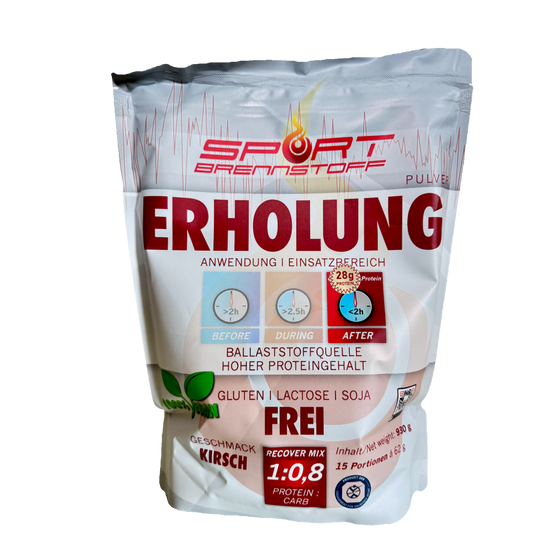
Hallo Daniel, vielen Dank für deine positive Rückmeldung! Es freut uns sehr zu hören, dass du mit unserem Recovery Shake so erfolgreich bist. Viel Erfolg weiterhin beim Muskelaufbau und der Regeneration! Dein Team von Sportbrennstoff