The biggest misconception in endurance sports is that one nutrition plan works for everyone. Those who ignore dosing sports nutrition for competition and training rely on luck instead of physiology. Standardized recommendations fail because they do not account for your body weight, sweat rate, or gastrointestinal reaction under adrenaline. Dosing sports nutrition individually means adjusting the intake of carbohydrates, electrolytes, and fluids precisely to your performance. Below, we show you how to develop your personal competition strategy using four adjustment knobs and a simple formula.
Why One-Size-Fits-All Dosing Recommendations Fail in Competition
One-size-fits-all dosing recommendations treat the athlete as an average that does not exist. Two runners with identical body weights can have completely different nutrient requirements at the same intensity, depending on sweat rate, glycogen stores, mineral stores, and gut flora. The result is stomach cramps, a performance drop in the second half, or an energy slump despite sufficient calorie intake.
In addition, one-size-fits-all tables are often based on studies involving average male athletes. Women, older athletes, or vegans, however, have different metabolic pathways. The German Sport University Cologne Guidelines on Individual Sports Nutrition emphasize that tolerance and bioavailability vary greatly. A recommendation of "60 to 80 grams of carbohydrates per hour" is a range, not a plan. The art lies in determining your personal sweet spot.
Dosing Sports Nutrition Individually: The 4 Adjustment Knobs for Your Competition Strategy
Anyone who wants to dose sports nutrition must know four variables that determine your requirements. These four adjustment knobs replace guesswork with reliable calculations.
Body Weight and Sweat Rate as a Baseline
Your body weight determines the absolute energy requirement, while your sweat rate determines your fluid and electrolyte requirements. An athlete weighing 85 kilograms requires more carbohydrates per hour than a 60-kilogram runner at the same intensity. You determine your sweat rate during training: weigh yourself naked before and after a one-hour session, drink a defined amount, and calculate the difference.
Correctly Assessing Exercise Intensity and Duration
Exercise intensity determines whether your body depends on external carbohydrates at all. At moderate intensity, the body preferentially uses fats and stored glycogen. Only when glycogen stores become the performance limiting factor does carbohydrate intake come into play. Duration determines the total amount: a 90-minute race requires a different strategy than an Ironman.
Calculating Carbohydrate Requirements per Hour: Formula and Examples
The formula for calculating carbohydrate requirements per hour is: body weight in kilograms multiplied by an intensity factor between 0.5 and 1.2 grams per kilogram. For exercise lasting less than two hours, choose a factor of 0.5 to 0.8; for ultra-endurance exercise lasting over three hours, the factor increases to 1.0 to 1.2. A 70-kilogram triathlete in an Ironman therefore needs between 70 and 84 grams of carbohydrates per hour.
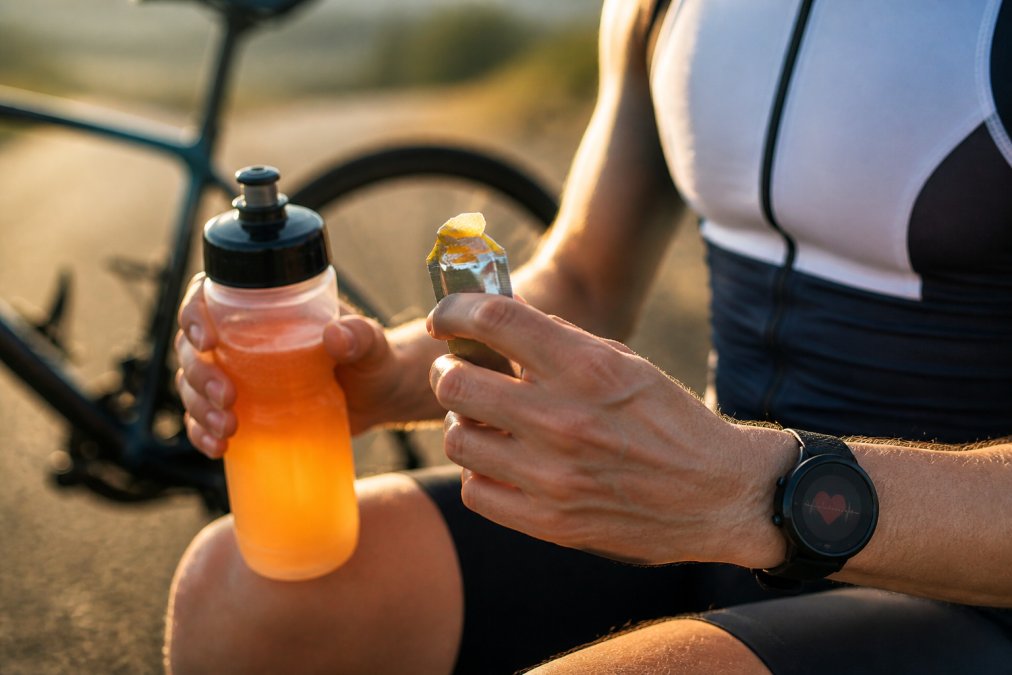
Triathlete holds sports gel and electrolyte drink for dosing sports nutrition correctly during a training break
These values are only the theoretical framework. In practice, the bottleneck is often the oxidative capacity of the gut, which can be improved through training. Scientific foundations are provided by the University of Bayreuth Overview of Carbohydrate Oxidation During Endurance Exercise. Start at the lower end of the scale and increase the intake by five grams each week until you can metabolize the desired amount without discomfort.
Avoiding Gastrointestinal Problems in Competition: How to Protect Your Digestive Tract
Avoiding gastrointestinal problems in competition is often more important than the optimal calorie amount. Under competition stress, blood flow to the gut is reduced, and nutrient absorption suffers. The most common cause of cramps is an excessively high single dose, not the total amount per hour. Distribute the intake into smaller portions every 15 to 20 minutes.
WarningA common mistake is trying a new gel or drink on race day just because it is offered at the aid station. Your gut does not know this composition and reacts with cramps or nausea. Use exclusively products that you have tested in training under similar exercise intensity.
Electrolytes and Fluids: More Than Just Water
Electrolytes and fluids are the second pillar of your competition nutrition, because pure water can dangerously dilute the electrolyte balance. Sodium promotes water absorption in the gut and stabilizes the fluid balance. Pure water replacement without electrolytes leads to a drop in blood sodium concentration during long exercise, which can cause nausea and confusion.
The required amount of sodium depends directly on your sweat rate. A salt film on the skin or burning eyes are indicators of high salt loss. Fluid intake should be based on the determined sweat rate, not on a fixed drinking plan. Overhydration is just as performance-limiting as dehydration.
Calculating Sodium Requirements: How to Determine Your Needs
The sodium concentration of your sweat varies individually between 400 and 2,000 milligrams per liter. A simple field test helps: After an intense session, wipe your forearm dry, wait ten minutes, and scrape off the sweat layer. Taste it carefully - salty to very salty indicates high sodium loss. It becomes more precise with a sweat test patch from a specialty store.
With a sweat rate of 1.2 liters per hour and an average sodium loss of 1,000 milligrams per liter, you lose 1,200 milligrams of sodium per hour - about three grams of table salt. Common electrolyte drinks contain 400 to 800 milligrams of sodium per liter; with high loss, you only cover half of that. The solution: Combine an electrolyte drink with salty snacks or use sodium capsules in the second half of the competition.
Potassium and Magnesium: The Storage Minerals
Potassium is crucial for muscle contraction and nerve conduction. A deficiency arises less from sweat loss than from a one-sided diet. Dried apricots or potatoes provide more potassium per serving than bananas. For the competition itself, a potassium supplement is usually unnecessary if you eat sufficiently potassium-rich foods in the 48 hours beforehand. Here, the store is used that you built up during preparation.
Magnesium losses through sweat are low, but not negligible during multi-hour exercise. A deficiency manifests as calf cramps. The German Nutrition Society recommends 300 to 400 milligrams daily. In the context of competition, magnesium intake during the preparation period is more sensible, as magnesium can slow down gastric emptying. Here too, it is more of a storage mineral.
Fluid Strategy: Drinking According to Plan or Thirst?
The old recommendation to drink at fixed time intervals is outdated. Current guidelines recommend a drinking strategy based on the measured sweat rate. At 1.2 liters per hour, that is 300 to 400 milliliters every 15 minutes. This amount should be tested over several training sessions.
Isotonic drinks with 280 to 300 milliosmoles per liter are absorbed the fastest. Hypotonic drinks are suitable for pure fluid intake, hypertonic solutions slow down gastric emptying. A look at the label will tell you whether the product is in the isotonic range.
WarningPay attention to the combination of carbohydrates and electrolytes in the same drink. A carbohydrate concentration of over eight percent increases osmolarity and can impair sodium absorption. For intense exercise lasting over two hours, it is often better to take carbohydrates as a gel or bar and electrolytes separately.
Electrolyte
Function
Typical loss per liter of sweat
Recommended intake for high loss
Sodium
Fluid balance, nerve conduction
400-2,000 mg
800-1,500 mg/h
Potassium
Muscle contraction
150-400 mg
Cover through diet
Magnesium
Muscle relaxation
20-80 mg
300-400 mg/day, before the competition
Chloride
Acid-base balance
500-2,500 mg
Take together with sodium
The fluid strategy is a dynamic process. Heat, humidity, and intensity change your sweat rate daily. Those who adapt flexibly and take body signals seriously avoid both dehydration and overhydration.
Testing Competition Nutrition in Training: The 4-Week Plan
Testing competition nutrition in training follows a clear 4-week plan. Week one: You determine your sweat rate and keep a nutrition log. In week two, you integrate the planned carbohydrate amount into a long session and reduce fiber intake 24 hours beforehand. Week three simulates competition conditions: same start time, same intensity, same products. In week four, you increase the intensity to competition level and check the tolerance.
Pro TipIn your final test run, simulate not only the pace but also the emotional tension. Many athletes can easily tolerate the same amount during relaxed training but fail under race-day adrenaline. A trial run with a race bib and timing will reveal this discrepancy.
Pay attention to signals such as a feeling of fullness, burping up gels, or unexpected fatigue. Document the results in a table showing exercise intensity, intake amount, and subjective well-being. This plan is the only way to ensure that your strategy holds up on race day.
Supplement Periodization: Training Phase Determines the Dose
Supplement periodization means adjusting the dosage to the overall training cycle. During the base phase, the need for external carbohydrates is low, as the body is meant to train fat oxidation. During intensive race preparation, the need for readily available energy increases. Those who already consume the race dose during the base phase undermine metabolic adaptation and risk weight gain.
Recovery is also affected. Immediately after intense sessions, the window for replenishing glycogen stores is largest. Post-workout intake of carbohydrates and proteins supports active recovery, while a normal meal is often sufficient during the base phase. A flexible system beats a rigid plan because it reflects the exercise intensity of the respective week.
Common Dosing Mistakes and How to Avoid Them
The most common dosing mistake is overdosing in the initial phase. Many athletes look at the maximum values of professionals and wonder about stomach problems. Your gut must first train its absorption capacity. Start conservatively and increase the amount over several weeks. Another mistake is neglecting the amount of liquid in which the carbohydrates are dissolved—too little liquid leads to overconcentration in the stomach.
The third source of error is neglecting individual tolerance in favor of supposedly scientific ideals. The recommendations of the German Federal Institute for Sports Science on race nutrition emphasize that practical testing under race conditions is the decisive factor. Trust your data from the 4-week plan, not the advertising of other providers.
The Four Most Common Mistakes in Detail: How to Recognize Them Early
Mistake 1: The single dose is too large. The stomach can only process about 1 to 1.5 milliliters of liquid per kilogram of body weight per minute. At 70 kilograms, that is 420 to 630 milliliters in ten minutes. A larger amount stays in the stomach and slows down nutrient absorption. The solution: Distribute the intake into portions of 150 to 200 milliliters every 15 to 20 minutes.
Mistake 2: The carbohydrate concentration is too high. A drink with more than eight percent carbohydrates significantly delays gastric emptying. If you take in 90 grams per hour over only 500 milliliters of liquid, that results in 18 percent—far above the optimum. The solution: For high amounts, use a combination of a hypotonic drink and gels or bars.
Mistake 3: The switch to new products happens too late. The gut flora needs two to three weeks to get used to a new composition. The solution: Test new products at least four weeks before the race at the planned dosage.
Mistake 4: The body's signals are ignored. Burping, pressure in the upper abdomen, or a drop in performance are warning signs, not normal side effects. The solution: Keep a logbook with a scale from 1 to 10 for stomach comfort and energy level. If stomach comfort falls below 7, reduce the amount by 20 percent and increase it more slowly.
The 80/20 Rule of Race Dosing
A proven rule of thumb: 80 percent of athletes cope better with a moderate dose than with the maximum. The optimal amount is often 70 to 80 percent of the theoretical upper limit. A 70-kilogram athlete with a theoretical maximum of 84 grams often does better with 60 to 65 grams—performance remains stable and the stomach stays calm. The remaining 20 percent, mostly with a gut trained for years, can use the full amount.
Decision Logic for Discomfort: Reduce, Change, or Switch?
For stomach problems, systematic troubleshooting helps. First question: Is the total amount per hour too high? Reduce by 20 percent and observe two sessions. Second question: Is the single dose too large? Reduce the portions and increase the frequency. Third question: Is the osmolarity too high? Switch to a hypotonic drink and take the carbohydrates separately. Only when all three adjustment knobs have been adjusted and the discomfort remains is a product switch useful.
Pro TipTake an error checklist on a waterproof piece of paper with you to training. After each session, note: total amount, single dose, liquid amount, stomach comfort (1-10), energy level (1-10). After three sessions, you will see which variable correlates with the discomfort. This data is more valuable than any theoretical recommendation.
The most common dosing mistakes are avoidable if you understand the mechanisms and test systematically. Gastrointestinal tolerance can be trained, but it takes time. Those who know the four sources of error and work with clear decision logic eliminate the most common cause of performance drops in competition.
Frequently Asked Questions
How do I calculate my individual carbohydrate requirement per hour in competition?
Multiply your body weight in kilograms by the guideline for your exercise intensity. At moderate intensity, that is about 0.8 grams per kilogram per hour, at high intensity up to 1.2 grams. A 70 kg athlete therefore needs about 84 grams of carbohydrates per hour at high intensity. You distribute this amount over several portions of 15 to 20 grams every 15 to 20 minutes to maintain stomach tolerance.
Why is individual dosing of sports nutrition crucial for stomach tolerance?
Every digestive tract processes nutrients at different speeds. Too high a single dose overwhelms the absorption capacity of the gut, leading to cramps, nausea, or diarrhea. Individual dosing takes into account your body weight, your training history, and your personal tolerance. Start with lower doses and increase slowly. Pay attention to products that combine different types of sugar such as glucose and fructose, as these are absorbed through different transporters.
What role does the sweat rate play in the dosing of electrolytes?
The sweat rate determines how much sodium and liquid you need to replace per hour. Depending on the person and conditions, it is between 0.5 and 2.0 liters per hour. Weigh yourself before and after a one-hour training session: Every lost kilogram corresponds to about one liter of liquid. A sweat test in the lab can additionally determine your sodium concentration. The higher your sweat rate, the higher the electrolyte dose must be in your drink.
How do I test my race nutrition in training?
Simulate the exact conditions of the race in training: same intensity, same time, and same ambient temperature. Plan at least four to six training sessions in which you run through your entire nutrition strategy. Start with half the planned dose and increase it per session. Note tolerance, energy level, and stomach reactions. Also test your breakfast routine and the first hour after the start, as this is where most problems occur.
What diet should I follow before a race?
In the last three days before the race, you increase your carbohydrate intake to 8 to 12 grams per kilogram of body weight per day. You eat your last large meal about three to four hours before the start; it should be low in fat and easy to digest. One hour before the start, you consume a small portion of 15 to 30 grams of carbohydrates. Avoid new foods and stick to what you have tested in training.
What are the most common mistakes when dosing gels and bars?
The most common mistake is consuming too much at once. A gel often contains 20 to 25 grams of carbohydrates, which should be drunk over 20 to 30 minutes. Many athletes also underestimate the water requirement: For every 10 grams of carbohydrates, you need about 100 to 150 milliliters of water. Another mistake is waiting until you feel hungry to eat. You must replenish your energy stores regularly before the glycogen stores are empty.
Hat einen angenehmen neutralen Geschmack und geht direkt in die Beine! Nutze es in fast jedem Training für meinen Ironman 👍
Hallo Melanie, vielen Dank für deine tolle Rückmeldung! Schön, dass dir der neutrale Geschmack gefällt und dich unser Sportgetränk bei deinen Ironman-Trainings unterstützt. Wir wünschen dir weiterhin viel Erfolg und starke Beine! :-)
Das Wettkampf-Sportgetränk hat meine Erwartungen voll erfüllt
Das Wettkampf-Sportgetränk hat meine Erwartungen voll erfüllt. Über die gesamte Zeit des Radfahrens (Langdistanz) konnte ich das Getränk zuführen und kam ohne spürbares Energiedefizit in T2 an.
Angenehmer, nicht aufdringlicher oder vordergründiger Geschmack.
Hallo Jens, vielen Dank für deine tolle Rückmeldung! Schön, dass dich das Sportgetränk auf deiner Langdistanz zuverlässig versorgt hat und dir der angenehme, dezente Geschmack gefällt. Wir wünschen dir weiterhin viel Erfolg bei deinen Wettkämpfen! Ingolf
Mit diesen beiden Produkten kommt man wirklich in der Aufbauphase sehr gut klar
Mit diesen beiden Produkten kommt man wirklich in der Aufbauphase sehr gut klar.
Hallo Daniel, danke für dein tolles Feedback! Es freut uns sehr, dass das Basispaket dir in der Aufbauphase so gut hilft. Viel Erfolg weiterhin beim Training!
Tatsächlich ist das 6 Tage in der Woche beim Frühstück dabei
Tatsächlich ist das 6 Tage in der Woche beim Frühstück dabei. Innerhalb von einer halben Stunde ist meine Energie geladen und kann direkt ins Training einsteigen. Noch nie Probleme beide Verdauung
Hallo Daniel, vielen Dank für deine tolle Rückmeldung! Es freut uns sehr, dass das Sportgetränk dich so zuverlässig beim Frühstück und beim Start ins Training unterstützt – und du es gut verträgst. Weiterhin viel Freude beim Training! Ingolf
Super Preis Leistungsverhältnis, wir setzen es zum Muskelaufbau und zur Regeneration ein . Wir sind seit vier Monaten sehr erfolgreich mit diesem Produkten.
Hallo Daniel, vielen Dank für deine positive Rückmeldung! Es freut uns sehr zu hören, dass du mit unserem Recovery Shake so erfolgreich bist. Viel Erfolg weiterhin beim Muskelaufbau und der Regeneration! Dein Team von Sportbrennstoff