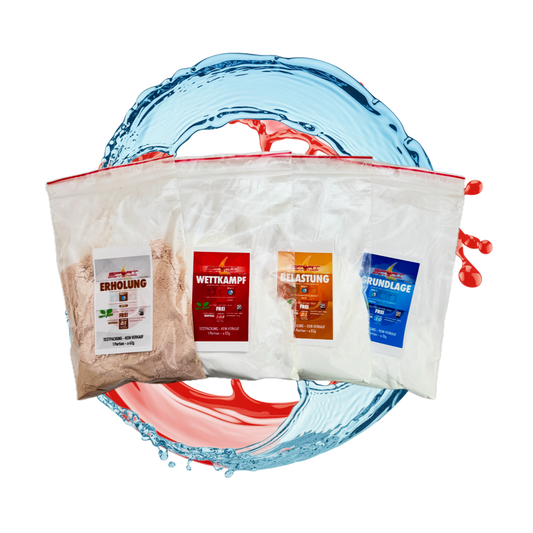
When buying liquid energy for long runs, use three criteria: carbohydrates per hour, digestibility, and packaging. A pouch with 40 g of carbohydrates is one serving, not an hourly plan. Calculate the price per serving and test the combination in training before the race.
The serving size on the package is not your hourly requirement.
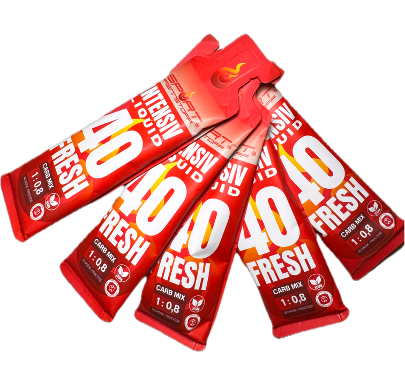
Our liquid energy provides 40 g of carbohydrates per 61-g pouch.
The sports drink makes ten standard servings of 90 g of carbohydrates each.
One pouch of INTENSIV costs €2.99; the price per serving is what matters.
Test the quantity, timing, and combination in at least two to three long sessions.
Which liquid energy is right for your run?SportBrennstoff offers vegan, stomach-friendly sports nutrition with 40 g of carbohydrates per serving pouch.
Buying liquid energy for long runs: What really matters
Anyone looking to buy liquid energy for long runs will quickly find themselves facing a shelf full of pouches, powders, and bars that all sound similar. The difference is not determined by the label, but by three things: how many carbohydrates you need per hour, how well your stomach tolerates the intake, and whether the packaging suits your route. SportBrennstoff products use a glucose-fructose ratio of 1:0.8. This guide shows you how to plan your nutrition instead of just buying a package.
Liquid energy is a carbohydrate source in a drinkable consistency that you take directly from the serving pouch during sports, without chewing and without mixing powder.
The most important point upfront: The serving size on the package is not your hourly requirement. A pouch with 40 g of carbohydrates is one unit, not a plan. How many units you need depends on the run duration, intensity, and your proven tolerance. That is exactly what the rest of this article is about.
Liquid energy, energy gel, and sports drink: the differences
Three forms of delivery, three functions. Liquid energy in a serving pouch provides a concentrated amount of carbohydrates per grab and is suitable for direct consumption on the go. A classic energy gel is thicker and often requires additional water. A sports drink made from powder distributes the carbohydrates through fluid intake, thereby covering two needs at the same time.
In practice, this means:
Liquid energy: high carbohydrate density, no chewing, no mixing, good for tight time windows during a race
Energy gel: similarly concentrated, but thicker, usually combined with water
Sports drink: carbohydrates and fluid in one, but more volume in the stomach
SportBrennstoff INTENSIV – Energy liquid with 40 g of carbohydrates
Planning carbohydrates per hour for running correctly
The amount of carbohydrates per hour is the central lever of your race nutrition. A common mistake is to orient yourself by the serving size instead of your own needs. Anyone who eats one pouch per hour because a pouch is one serving is planning past their actual consumption.
As a guide for your planning:
Run duration
Carbohydrates per hour
Typical form
Up to 60 minutes
usually no intake needed
Water
60-90 minutes
small amounts, if desired
one pouch of liquid energy
90-150 minutes
moderate intake, individually tested
liquid energy plus drink
Half marathon
even intake over the distance
Combination of liquid and drink
Marathon
high intake, clearly timed
Sports drink plus several liquids
Important: These ranges are starting points, not requirements. Your individual tolerance determines how much you can actually utilize. Therefore, plan the intake in training and not for the first time on race day.
Intake plan by run duration: 90 minutes, half marathon, marathon
An intake plan is a sequence of times, not a collection of products. For a 90-minute run, it is usually sufficient to take a small amount shortly before the start and once in the middle. For the half marathon, distribute the intake evenly over the distance instead of bundling it at the end. For the marathon, timing counts: early first intake, regular intervals, no experiments after kilometer 30.
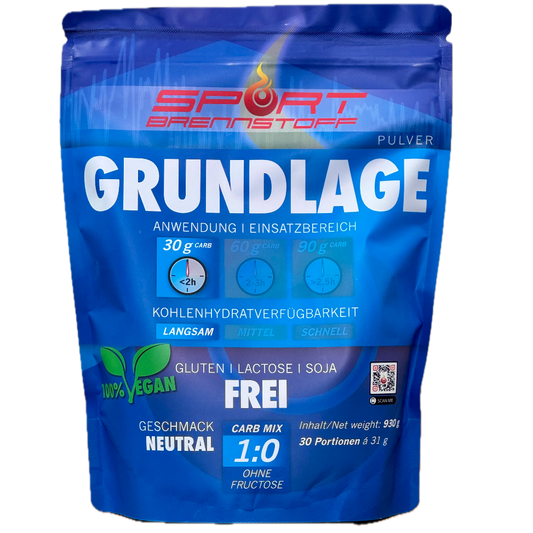
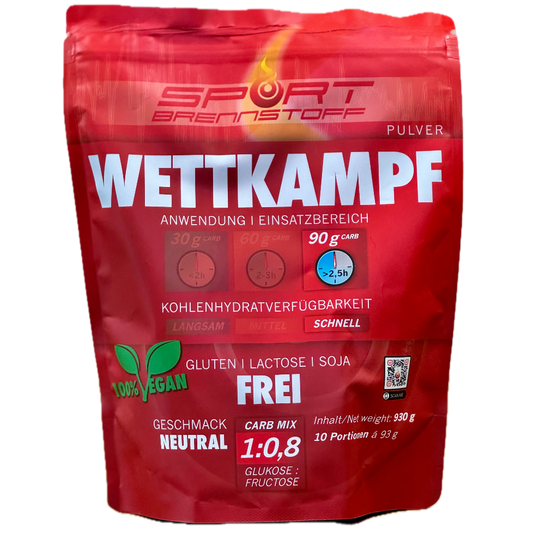
For long runs with high carbohydrate density, our sports drink with 90 g of carbohydrates per standard serving is designed: 93 g of powder in 750 ml of water, ten standard servings per pouch. It can be combined with liquid energy if your plan includes both forms.
SportBrennstoff WETTKAMPF – Sports drink with 90 g of carbohydrates
Energy gel with or without water: What the stomach really needs
The question of water with the gel is not a matter of taste, but a matter of digestion. Concentrated carbohydrates draw in fluid. Anyone who eats a gel without enough water risks a feeling of fullness that disrupts the run. Liquid energy reduces this problem because the consistency is already drinkable, but it does not automatically replace your fluid intake.
The mechanism behind it:
Two rules that have proven themselves in practice:
Drink a manageable amount of water with every concentrated carbohydrate intake, unless your plan deliberately calls for a sports drink at this point.
Do not completely separate high carbohydrate density and large amounts of fluid, otherwise an imbalance is created that the stomach feels. A sports drink with 90 g of carbohydrates in 750 ml of water provides both in one.
Warning: If you combine a new product with the planned amount of water for the first time on race day, you cannot predict your stomach's reaction; test the combination of pouch and amount of water beforehand in at least two long sessions.
Energy gel for running: Comparing liquid and thick variants
For energy gel for running, consistency determines how practical the intake is at the crucial moment. Thick gels have the advantage of being compact, but they require chewing or rinsing and a free hand. Liquid variants can be drunk directly from the pouch.
Here are the differences that matter in a race:
Criterion
Liquid energy
Thick gel
Consistency
drinkable
thick
Additional water
reduced need
usually required
Handling on the go
one-handed possible
often two-handed
Chewing
not necessary
partially necessary
Serving size
61 g pouch with 40 g of carbohydrates
varies by manufacturer
Testing energy gel in training: How to prepare before the race
Testing does not mean trying a product once. Testing means going through your planned race plan under realistic conditions. Take at least two to three longer sessions for this, in which you follow the quantity, timing, and combination exactly as on race day.
Female runner takes an energy gel from her jersey pocket during a training run along a river.
Here is how you do it:
Decide before the session how many carbohydrates you want to take in per hour
Pack exactly this amount, no more as a reserve
Note down your stomach feeling, energy level, and taste after the run
Repeat the session with the same combination before you change anything
Also test the nutrition at pace, not just on a slow base run
Buying criteria: Servings, price per serving, and packaging
When buying, the price per serving counts, not the package price. Calculate the carbohydrates per euro, then products can be compared fairly. One pouch of SportBrennstoff INTENSIV with 40 g of carbohydrates costs €2.99; the SportBrennstoff WETTKAMPF powder makes ten standard servings of 90 g of carbohydrates each.
The criteria we consider decisive:
Carbohydrates per serving: does the amount fit your hourly plan or do you have to portion it out?
Price per serving: package size divided by servings, not the shelf price
Packaging: individually pre-portioned for on the go, powder for planned drinks
Consistency: drinkable or thick, depending on the situation on the route
Digestibility: proven in training, not just in competition
Certification: Our products are Kölner Liste® certified
Packaging also raises the question of waste. Individual sachets are convenient, but they create waste on the route. Those who train a lot often find powder packs more convenient; those who need to grab something quickly during a race stick with preportioned sachets. Both have their place.
Your introduction with the SportBrennstoff trial package
Before you commit your entire season's nutrition to one product, you want to test it. That's exactly what our RACE-Package with sports drink and energy liquid is designed for: 930 g of sports drink powder for ten standard portions of 90 g of carbohydrates each, plus twelve INTENSIV FRESH portion sachets with 40 g of carbohydrates each. Both with glucose-fructose in a 1:0.8 ratio.
SportBrennstoff RACE-Package – Sports Drink & Energy Liquid
Here's how to use the package effectively: Mix the drink before the session, pack the liquids for on the go, and add both carbohydrate amounts to your remaining nutrition. A portion remains a portion; your needs per hour result from the combination.
Our products are vegan and Kölner Liste® certified. Developed by athletes for athletes. If you're unsure which form suits your training phase, our product advisor will help you choose.
The biggest hurdle is rarely the product, but the plan behind it. Those who clarify quantity, timing, and tolerance in training before race day have one less point to think about during the race. SportBrennstoff accompanies you with vegan products and Kölner Liste® certification. Start with the trial package and find out which combination suits your run.
Frequently Asked Questions
What liquid energy is suitable for long runs?
For long runs, a liquid carbohydrate source that can be consumed without chewing and without mixing powder is suitable. Pay attention to the carbohydrate amount per portion, a glucose-fructose ratio of 1:0.8, and sodium. SportBrennstoff INTENSIV provides 40 g of carbohydrates in a 61-g portion sachet and is designed as a liquid alternative to the classic energy gel. However, one portion is not automatically your hourly requirement, so the amount belongs in a nutrition plan.
Do you have to take energy gels with water?
Whether an energy gel is taken with or without water depends on the consistency. Thick gels are often accompanied by water to dilute them better and relieve the stomach. Liquid variants can be consumed directly from the sachet. Regardless of this, the amount of fluid remains a separate part of your plan: You plan fluid balance and carbohydrate supply separately, even though both work together.
How many carbohydrates per hour should you take in while running?
The amount depends on duration and intensity. For sessions over 90 minutes, 60 to 90 g of carbohydrates per hour is a common planning value, while for very long and intense exertion, the requirement may be higher. SportBrennstoff RACE provides 90 g of carbohydrates per standard portion from 93 g of powder in 750 ml of water. One portion does not automatically correspond to your hourly requirement, so you build up the plan step by step and test it in training.
How do I test liquid energy before a race?
Test your planned race nutrition in sessions that closely resemble the exertion, not in the race itself. Start with one portion in a relaxed 90-minute session and observe stomach tolerance and taste. After that, gradually increase the amount to your planned hourly value. Note down what you took and when. This way you can recognize which portion size and which intake time suit you before it counts.
Hat einen angenehmen neutralen Geschmack und geht direkt in die Beine! Nutze es in fast jedem Training für meinen Ironman 👍
Hallo Melanie, vielen Dank für deine tolle Rückmeldung! Schön, dass dir der neutrale Geschmack gefällt und dich unser Sportgetränk bei deinen Ironman-Trainings unterstützt. Wir wünschen dir weiterhin viel Erfolg und starke Beine! :-)
Das Wettkampf-Sportgetränk hat meine Erwartungen voll erfüllt
Das Wettkampf-Sportgetränk hat meine Erwartungen voll erfüllt. Über die gesamte Zeit des Radfahrens (Langdistanz) konnte ich das Getränk zuführen und kam ohne spürbares Energiedefizit in T2 an.
Angenehmer, nicht aufdringlicher oder vordergründiger Geschmack.
Hallo Jens, vielen Dank für deine tolle Rückmeldung! Schön, dass dich das Sportgetränk auf deiner Langdistanz zuverlässig versorgt hat und dir der angenehme, dezente Geschmack gefällt. Wir wünschen dir weiterhin viel Erfolg bei deinen Wettkämpfen! Ingolf
Mit diesen beiden Produkten kommt man wirklich in der Aufbauphase sehr gut klar
Mit diesen beiden Produkten kommt man wirklich in der Aufbauphase sehr gut klar.
Hallo Daniel, danke für dein tolles Feedback! Es freut uns sehr, dass das Basispaket dir in der Aufbauphase so gut hilft. Viel Erfolg weiterhin beim Training!
Tatsächlich ist das 6 Tage in der Woche beim Frühstück dabei
Tatsächlich ist das 6 Tage in der Woche beim Frühstück dabei. Innerhalb von einer halben Stunde ist meine Energie geladen und kann direkt ins Training einsteigen. Noch nie Probleme beide Verdauung
Hallo Daniel, vielen Dank für deine tolle Rückmeldung! Es freut uns sehr, dass das Sportgetränk dich so zuverlässig beim Frühstück und beim Start ins Training unterstützt – und du es gut verträgst. Weiterhin viel Freude beim Training! Ingolf
Super Preis Leistungsverhältnis, wir setzen es zum Muskelaufbau und zur Regeneration ein . Wir sind seit vier Monaten sehr erfolgreich mit diesem Produkten.
Hallo Daniel, vielen Dank für deine positive Rückmeldung! Es freut uns sehr zu hören, dass du mit unserem Recovery Shake so erfolgreich bist. Viel Erfolg weiterhin beim Muskelaufbau und der Regeneration! Dein Team von Sportbrennstoff