Carbohydrate Requirements for a Sub-3-Hour Marathon
A sub-3-hour marathon requires not only hard training but also the right sports nutrition for a marathon under 3 hours with precisely tailored race nutrition. Your body consumes enormous amounts of energy during a fast marathon, and without the right carbohydrate intake, you will collapse in the final kilometers. The best sports nutrition for a marathon under 3 hours is based on a scientifically sound strategy for continuous energy supply.
For a sub-3 run, you must run at an average speed of about 4:18 minutes per kilometer. This means your body is working at high intensity for 180 minutes. Your glycogen stores—the energy reserves in your muscles and liver—are depleted after about 90 minutes of intense running. After that, you depend on external carbohydrate intake to maintain your pace.
Key TakeawayWithout a continuous carbohydrate supply, you will lose performance dramatically from kilometer 20 onwards. The right sports nutrition is the difference between a successful sub-3 run and collapsing in the final phase.
The amount of carbohydrates you can consume per hour depends on your body weight, your training level, and above all, your gastrointestinal tolerance. Not every runner can process the same amount. Your goal should be to find out which dosage works optimally for you—and that can only be done through systematic training beforehand.
What to Eat 3 Hours Before the Race: The Optimal Meal
The meal 3 hours before the start is crucial for your energy supply in the first hours of the race. This meal should consist of easily digestible carbohydrates that give you energy quickly without burdening your stomach. Timing is critical: too close to the start and you will run with a full stomach; too far away and the energy will be depleted before you arrive.
Ideally, a meal with about 200-300 grams of carbohydrates, little fat, and moderate protein is best. Toast with jam, porridge with banana, or pasta are classic choices. Many successful marathon runners swear by simple carbohydrates that enter the bloodstream quickly—white bread instead of whole grain, sweet fruit instead of vegetables.
Pro TipTest your meal before the race in several long training runs. Your stomach on race day will react differently than in everyday training—nervousness and the adrenaline rush change digestion.
Important: Drink enough water with this meal, but not so much that you struggle with a full stomach during the run. About 400-500 ml of water is sufficient. Avoid caffeine during this phase—it can lead to stomach problems when combined with empty glycogen stores.
Carbohydrates per Hour of Marathon: Your Individual Dosage
The question of the right amount of carbohydrates per hour cannot be answered with a one-size-fits-all approach. Many runners follow the scientific recommendation of 60 to 90 grams of carbohydrates per hour, but this range is broad—and for a sub-3 run, you need to find your personal optimal dosage.
Your body weight plays a role. A lighter runner (under 70 kg) can often get by with 60 grams per hour, while a heavier runner (over 80 kg) may need 80-90 grams. Your race pace is also crucial: the faster you run, the higher your carbohydrate intake should be to keep pace with the energy consumption rate.
Tolerance is the critical factor. Some runners can easily process 90 grams per hour, while others get stomach cramps with just 70 grams. Your task is to find the maximum amount your stomach can tolerate under stress—without nausea, without cramps, without diarrhea.
Body Weight
Recommendation per Hour
Adjustment for Sub-3
Under 65 kg
50-60 g
60 g (if tolerated)
65-80 kg
60-75 g
75-80 g
Over 80 kg
75-90 g
80-90 g
CautionIf you consume 80+ grams of carbohydrates per hour for the first time in a race, you risk severe stomach cramps. Train this dosage in at least three long runs beforehand.
Energy Gel Intake During a Marathon: Timing and Frequency
In a sub-3 marathon, you run the first kilometers with full glycogen stores. That is exactly why the most common source of error is not too little intake, but too early and too irregular intake. Your stomach can only tolerate a limited volume during high intensity, and absorption competes with the blood flow to the leg muscles. A gel you take at kilometer 3 therefore brings you less than the same gel at kilometer 8—provided you have enough fluid in your stomach beforehand.
A practical pattern for a sub-3 pace:
Kilometer 5-8: first gel, then 150-200 ml of water at the next aid station
Kilometer 14-17: second gel, again wash down with water
Kilometer 23-26: third gel or a carbohydrate-containing sports drink
Kilometer 32-35: fourth gel
Kilometer 38-40: last small portion, only if your stomach still accepts it
There should be at least 25 to 30 minutes between two gels. Shorter intervals increase the risk that carbohydrates accumulate in the stomach because the emptying rate decreases at high running intensity. Longer intervals of more than 45 minutes, on the other hand, lead to the energy supply not keeping pace with consumption.
The carbohydrate source is important. A gel consisting exclusively of glucose or maltodextrin can only be absorbed by the body to a limited extent via the SGLT1 transporter—in practice, the upper limit is about 60 grams per hour. Mixtures of glucose and fructose additionally use the GLUT5 transporter and enable higher absorption rates. If your plan calls for 75 to 90 grams per hour, you therefore need either a gel with a corresponding 2:1 or 1:0.8 ratio or you combine gel and sports drink.
Pro TipWash down every gel with water, not with another carbohydrate-containing drink. Otherwise, the carbohydrate concentration in the stomach increases, emptying is delayed, and the risk of nausea increases.
Also pay attention to the consistency. Liquid gels are easier to swallow at a high breathing rate than thick or chewable bars. Anyone who has trouble swallowing at a sub-3 pace should switch to thin-liquid variants or a sports drink with 60 to 90 grams of carbohydrates per liter. A sports drink additionally has the advantage that it delivers fluid and carbohydrates in one step—however, you then have to plan the drinking volume accordingly at the aid stations.
Sub-3-Hour Marathon Nutrition Plan: A Concrete Example
A sub-3 plan differs from a general marathon plan in one point: The time windows are tighter, the aid stations are closer together at your pace, and you have less room to make up for a missed intake later. At 4:18 minutes per kilometer, you reach the usual aid stations approximately every 5 kilometers—that is around 21 to 22 minutes. You can use this rhythm directly as a pacemaker.
Runner receives a drink from a helper at an aid station during a marathon.
Example plan for a runner weighing 70 to 80 kg with a planned intake of about 80 grams of carbohydrates per hour:
3 hours before the start
Easily digestible carbohydrate meal with about 200 to 250 grams of carbohydrates, plus 400 to 500 ml of fluid. White bread with jam, porridge with banana, or light pasta with little sauce have proven themselves.
60 to 30 minutes before the start
300 to 500 ml of a sports drink with electrolytes. This replenishes the fluid reserves without burdening the stomach.
Kilometer 5 (approx. 21 minutes)
First gel with 30 to 40 grams of carbohydrates, then 150 to 200 ml of water at the aid station.
Kilometer 10 (approx. 43 minutes)
150 to 200 ml sports drink with 60 to 90 grams of carbohydrates per liter. Still no second gel—the stomach should get used to the intake.
Kilometer 15 (approx. 65 minutes)
Second gel, then water.
Kilometer 20 (approx. 86 minutes)
Sports drink at the aid station, 200 to 250 ml.
Kilometer 25 (approx. 108 minutes)
Third gel, then water. From here begins the phase in which the glycogen stores shrink significantly—the intake must now be continuous.
Kilometer 30 (approx. 129 minutes)
Sports drink, 200 to 250 ml.
Kilometer 35 (approx. 151 minutes)
Fourth gel, then water.
Kilometer 40 (approx. 172 minutes)
Last small carbohydrate portion, only if the stomach still accepts it. In the last two kilometers, it is no longer the intake that decides, but the energy already stored.
In total, this plan results in about 300 to 330 grams of carbohydrates over the race duration—a realistic but demanding dosage for sub-3 runners that must be tested beforehand in training.
CautionDo not rely on the fact that every aid station offers exactly what you need. Carry at least two gels on your body so that you can bridge a missed or overcrowded station. If you miss an intake, do not make it up with a double portion—instead, distribute it over the next two stations.
Emergency plan for stomach problems
If you feel nauseous from kilometer 25 onwards, it usually helps to drink only water for 10 to 15 minutes and postpone the next carbohydrate intake by one station. A thin-liquid gel or a highly diluted sports drink is then better tolerated than a thick gel. In case of stomach cramps, switching to a product with a different carbohydrate composition can help—for example, from a pure maltodextrin gel to a glucose-fructose mixture.
Adjustment to the race pace
If you run faster than planned, the energy consumption per minute increases, but the time between the aid stations decreases. At a 2:55 goal, the stations are only about 20 minutes apart.
Hydration and Electrolytes During the Race
Your fluid intake is just as important as your carbohydrate supply. During a fast marathon, you lose large amounts of fluid and electrolytes through sweat—especially sodium. A fluid loss of just 2% of your body weight can reduce your performance by up to 10%.
The rule of thumb is: Drink about 150-200 ml of water or sports drink at every aid station. This is enough to compensate for your fluid loss without overloading your stomach. In warm weather or if you sweat more, it can also be a little more—but no more than 250 ml at a time.
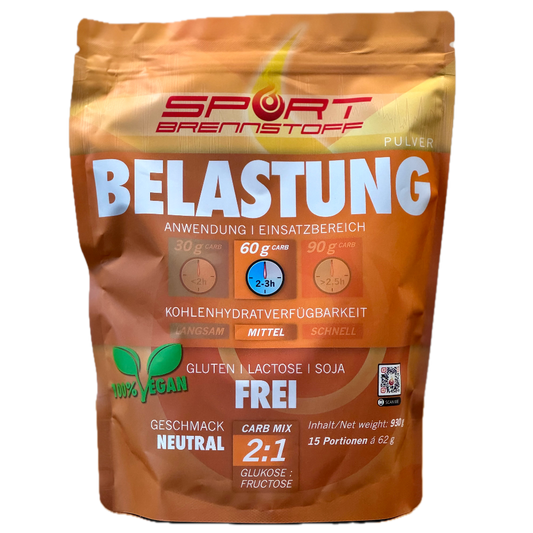
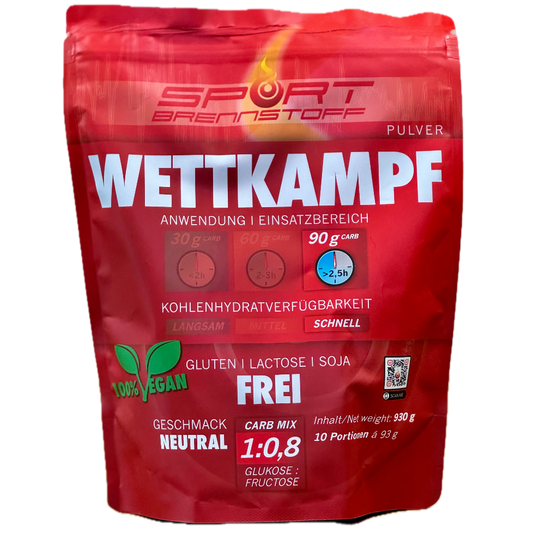
Electrolytes are crucial. Sodium helps your body store and process fluid. SportBrennstoff WETTKAMPF contains sodium chloride and is therefore ideal for long races. Without sufficient sodium, you risk hyponatremia—a dangerous condition in which your blood becomes too diluted.
SportBrennstoff WETTKAMPF – Sports drink with 90 g of carbohydrates
A simple plan for your fluid intake:
Every 20-30 minutes: drink 150-200 ml
Each drink should contain carbohydrates (60-90 g per liter) and sodium (500-700 mg per liter)
In the heat: drink a little more often, but no more per serving
Test your sports nutrition during training
The most common mistake marathon runners make is not testing their race nutrition sufficiently during training. You cannot expect your body to suddenly process 80 grams of carbohydrates per hour in a race if you have never trained it before.
Start by testing your nutrition during long training runs of over 90-120 minutes. Start with a conservative dosage - about 40-50 grams of carbohydrates per hour - and gradually increase.
A proven approach is the so-called "Train the Gut" - you train your stomach to process larger amounts of carbohydrates during intense exercise. It works similarly to muscle training: With regular repetition, your digestive system adapts and can process more.
At least three long training runs should include your planned race nutrition and dosage. Ideally, you keep a training log: Which products did you use? How did you feel? Where did you have problems? This data is invaluable when you need to refine your race plan.
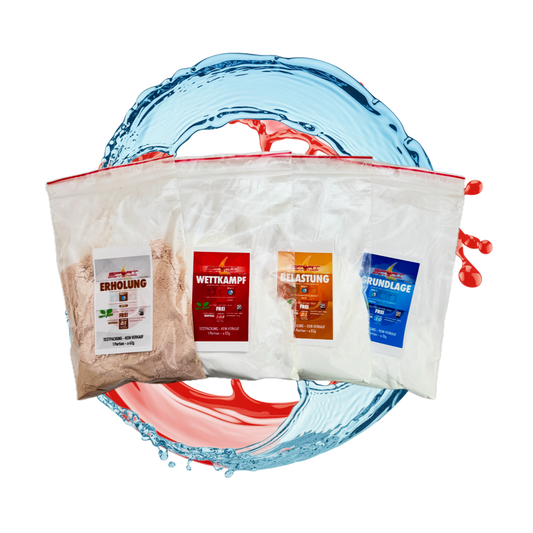
SportBrennstoff also offers individual advice - a 30-minute one-on-one consultation on sports nutrition can help you optimize your plan based on your personal experiences.
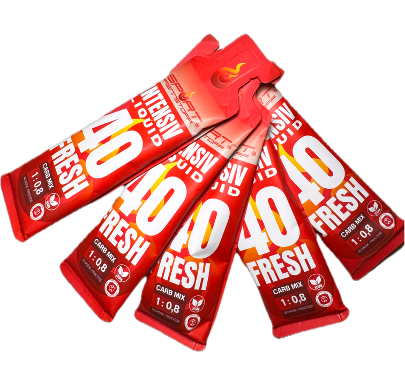
A successful sub-3 marathon depends 30% on training and 70% on the right nutrition - that is no exaggeration. The SportBrennstoff WETTKAMPF package combines proven carbohydrate sources with practical delivery forms that allow you to keep your energy levels constant.
SportBrennstoff WETTKAMPF package – Sports drink & Energy Liquid
Start now with your tests for a sub-3-hour marathon sports nutrition. Every run is an opportunity to refine your strategy. If you can still maintain the pace at kilometer 38 on the home stretch while others collapse, you will understand why the right nutrition is the biggest lever for your success.
How many carbohydrates should I consume during a marathon?
The recommendation is 60-90 grams of carbohydrates per hour, depending on your body weight, pace, and stomach tolerance. Lighter runners (under 70 kg) often get by with 60 grams, heavier runners benefit from up to 90 grams. Start with an amount you have tested during training, and only increase it if your stomach can tolerate it.
What should I eat before a marathon?
Three hours before the start: an easily digestible meal with 1-4 grams of carbohydrates per kilogram of body weight (e.g., toast with jam, porridge, or pasta). Choose foods that you tolerate well, and avoid fat, fiber, and too much protein. One hour before the race: only small amounts of fluid and fast carbohydrates, if necessary.
When should I take an energy gel during a marathon?
Start your energy intake from kilometer 8-10, not just from kilometer 15. This stabilizes your blood sugar and prevents a later drop in performance. For a sub-3 marathon with 90-minute aid stations: take a gel or liquid every 30-45 minutes, always with enough water, to prevent stomach problems.
Which sports nutrition is particularly stomach-friendly during a marathon?
Liquid carbohydrate sources such as sports drinks and energy liquids are often tolerated better than solid gels or bars, especially under exertion. Choose products with a balanced glucose-fructose mix (e.g., 1:0.8), as these are absorbed faster. Test your chosen nutrition during long training runs to avoid stomach cramps.
Hat einen angenehmen neutralen Geschmack und geht direkt in die Beine! Nutze es in fast jedem Training für meinen Ironman 👍
Hallo Melanie, vielen Dank für deine tolle Rückmeldung! Schön, dass dir der neutrale Geschmack gefällt und dich unser Sportgetränk bei deinen Ironman-Trainings unterstützt. Wir wünschen dir weiterhin viel Erfolg und starke Beine! :-)
Das Wettkampf-Sportgetränk hat meine Erwartungen voll erfüllt
Das Wettkampf-Sportgetränk hat meine Erwartungen voll erfüllt. Über die gesamte Zeit des Radfahrens (Langdistanz) konnte ich das Getränk zuführen und kam ohne spürbares Energiedefizit in T2 an.
Angenehmer, nicht aufdringlicher oder vordergründiger Geschmack.
Hallo Jens, vielen Dank für deine tolle Rückmeldung! Schön, dass dich das Sportgetränk auf deiner Langdistanz zuverlässig versorgt hat und dir der angenehme, dezente Geschmack gefällt. Wir wünschen dir weiterhin viel Erfolg bei deinen Wettkämpfen! Ingolf
Mit diesen beiden Produkten kommt man wirklich in der Aufbauphase sehr gut klar
Mit diesen beiden Produkten kommt man wirklich in der Aufbauphase sehr gut klar.
Hallo Daniel, danke für dein tolles Feedback! Es freut uns sehr, dass das Basispaket dir in der Aufbauphase so gut hilft. Viel Erfolg weiterhin beim Training!
Tatsächlich ist das 6 Tage in der Woche beim Frühstück dabei
Tatsächlich ist das 6 Tage in der Woche beim Frühstück dabei. Innerhalb von einer halben Stunde ist meine Energie geladen und kann direkt ins Training einsteigen. Noch nie Probleme beide Verdauung
Hallo Daniel, vielen Dank für deine tolle Rückmeldung! Es freut uns sehr, dass das Sportgetränk dich so zuverlässig beim Frühstück und beim Start ins Training unterstützt – und du es gut verträgst. Weiterhin viel Freude beim Training! Ingolf
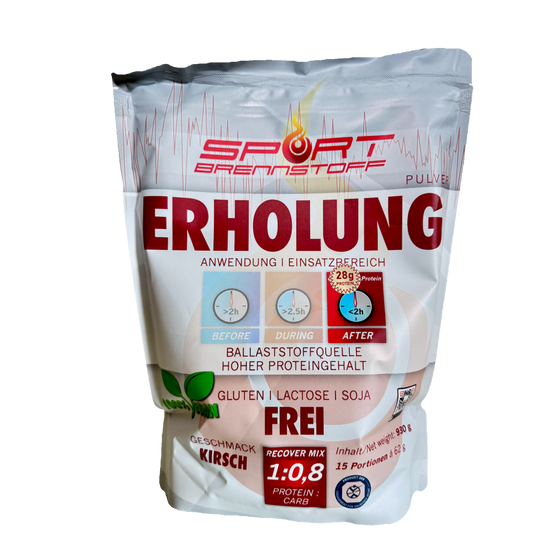
Super Preis Leistungsverhältnis, wir setzen es zum Muskelaufbau und zur Regeneration ein . Wir sind seit vier Monaten sehr erfolgreich mit diesem Produkten.
Hallo Daniel, vielen Dank für deine positive Rückmeldung! Es freut uns sehr zu hören, dass du mit unserem Recovery Shake so erfolgreich bist. Viel Erfolg weiterhin beim Muskelaufbau und der Regeneration! Dein Team von Sportbrennstoff