Why natural sports drinks make sense for long-distance runners
Anyone who regularly runs for over 90 minutes loses not only water through sweat, but above all sodium. Natural sports drinks for long-distance runners address exactly this: they replace fluids and electrolytes with ingredients you can control yourself, rather than relying on ready-made mixtures with long ingredient lists. At SportBrennstoff, we focus on how to cleanly combine energy supply and stomach tolerance during endurance exercise.
The crucial point: a drink is only good if your stomach still accepts it at kilometer 30. Many runners underestimate how overly concentrated or incorrectly formulated mixtures can slow down fluid absorption. The German consumer protection agency rightly points out that the ingredient list of ready-made products often reveals more about their actual benefits than the marketing on the front.
This article shows you how to make isotonic drinks yourself, how to replace electrolytes naturally, and what matters for stomach-friendly sports drinks.
Making isotonic drinks yourself: recipes for on the go
Making isotonic drinks yourself means mixing water, a carbohydrate source, and salt so that the concentration resembles that of blood. This allows fluid to flow more quickly from the stomach into the small intestine, helping you maintain performance.
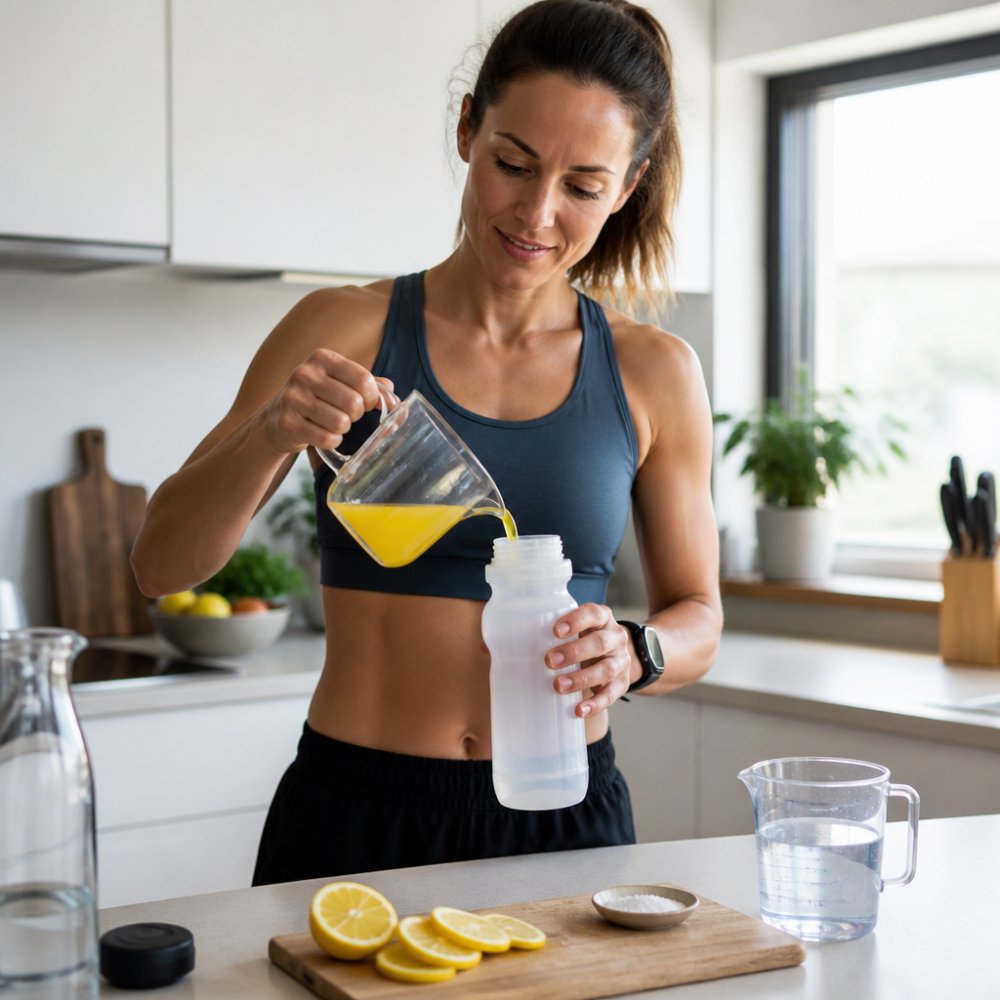
A long-distance runner in running gear fills a water bottle with a homemade sports drink made from water, fruit juice, and a pinch of salt at a light-colored kitchen counter, with lemon slices and a measuring cup beside her
Basic recipe: water, salt and fruit juice
For around 750 ml of drink, you need about 500 ml of mineral water, 200 ml of fruit juice, and a small pinch of table salt. The fruit juice provides glucose and fructose, while the salt replaces sodium losses. A splash of lemon juice improves the taste without further affecting blood sugar levels.
A common mistake is using too much juice. This makes the mixture hypertonic, drawing water into the small intestine and putting pressure on the stomach. Stick to a ratio of two parts water to one part juice.
Carbohydrate sources for long runs
For runs up to 90 minutes, a combination of fruit juice and water is usually sufficient. Beyond that, maltodextrin is worth considering because it tastes less sweet and is less irritating to the stomach than pure glucose. A mixture of maltodextrin and fructose in a ratio of approximately 2:1 improves absorption through the small intestine.
Replacing electrolytes naturally: sodium, potassium and magnesium
Replacing electrolytes naturally means getting them from food rather than powders: sodium is found in table salt, potassium in bananas, potatoes, and fruit juices, and magnesium in nuts, oats, and pumpkin seeds. For most training sessions, it is enough to deliberately incorporate these sources into your everyday diet.
Sodium is the most important electrolyte during long-distance running. It keeps electrolyte balance stable and supports muscle contraction. Potassium and magnesium play a smaller but real role in recovery. If you sweat heavily, you may notice salty residue on your skin—a good indicator of your own sodium requirements.
Pro tipA simple self-test: weigh yourself before and after a long session without refilling your drink. The difference shows your fluid loss. For every kilogram lost, you should replenish around 1 to 1.5 liters of fluid.
Stomach-friendly sports drinks: what relieves the stomach during long distances
Stomach-friendly sports drinks are those that do not strain the stomach through excessive concentration or too much fructose or acid. This is where most recipes from the internet fail, and where success or failure on runs over two hours is decided.
Osmolality and gastric emptying: the mechanisms
Osmolality describes the particle concentration of a solution, measured in milliosmoles per kilogram (mOsm/kg). Blood is around 280–300 mOsm/kg (Serum Osmolality). If a drink is higher (hypertonic), fluid remains in the stomach until it is diluted with gastric juices to a suitable level. This delays gastric emptying, puts pressure on the stomach, and can lead to nausea at kilometer 25.
A hypotonic mixture (below 280 mOsm/kg) or an isotonic mixture (280–300 mOsm/kg) leaves the stomach more quickly. Rule of thumb: the closer the concentration is to that of blood, the smoother the passage. This is why the ratio of two parts water to one part juice in the basic recipe is not a matter of taste, but a physiological necessity.
Fruit acid: the underestimated disruptive factor during long runs
Fruit acid, especially citric, malic, and tartaric acids, can irritate the stomach lining during several hours of exercise. The stomach reacts to acid by increasing mucus production and slowing emptying. For sensitive runners, this can lead to heartburn, a feeling of fullness, or nausea.
Practical consequence: use lemon juice sparingly (a maximum of one splash per 750 ml) and, if you know you have a sensitive stomach, switch to low-acid alternatives such as apple juice or grape juice. If you are on the go, avoid highly acidic ready-made drinks with citric acid as the main ingredient. Natural sweetness can also be achieved with healthy honey alternatives, which strain the stomach significantly less during intense exercise than industrially processed sugar additives.
Concrete strategies for competition
Check the concentration: A simple guide is the taste test: if the mixture tastes significantly sweeter than water, it is probably hypertonic. The goal is a slightly sweet, but not syrupy, taste.
Small sips, high frequency: 150–200 ml every 15–20 minutes is gentler on the stomach than 500 ml at once. The stomach processes small, continuous amounts better than sudden loads.
Limit fructose: Fructose is absorbed through a different transporter than glucose and can lead to bloating and cramps in larger amounts (over about 30 g per hour without accompanying glucose) (pubmed.ncbi.nlm.nih.gov). The 2:1 ratio (glucose to fructose) is a proven compromise.
Test, test, test: Every mixture must be tried in at least three long training sessions under competition-like conditions. Race day is no day for experimentation.
WarningAn unknown drink on race day is one of the most common causes of stomach problems in the final kilometers. Test every new mixture beforehand in several long sessions.
When you should use ready-made products
Homemade mixtures are completely sufficient for base training and moderate exercise. However, as soon as you push yourself to your limits in competition and need to scale carbohydrate intake to 90–120 g per hour, exact dosing becomes difficult. Here, tested ready-made products with an optimized glucose-fructose ratio and documented osmolality offer a reproducible advantage, provided they have been tested beforehand.
Doping-free supplements for triathletes: certificates and quality
Doping-free supplements for triathletes mean: the product has been tested for banned substances, and this testing is documented in a verifiable way. The Kölner Liste® is an established standard in Germany because it evaluates products based on batch analyses. This goes beyond a mere manufacturer's declaration.
This is exactly where SportBrennstoff comes in: our products are Kölner Liste® certified, vegan, and tailored to different levels of exercise. For athletes who want to play it safe at every competition, this testing is not an extra, but a basic requirement.
Individual sweat analysis and seasonal adjustment
Individual sweat analysis means knowing your own fluid and sodium losses instead of working with average values. Two runners at the same pace can sweat completely differently; sweat rate varies by a factor of two to three depending on body weight, fitness, acclimatization, and genetics.
Calculating sweat rate: the weighing method
The simplest and most reliable method is the weighing method:
Weigh yourself naked and dry before the session.
Run a defined distance (ideally 60–90 minutes) at a constant pace.
Drink nothing during the run and do not urinate.
Weigh yourself naked and dry immediately after the run.
The difference in kilograms corresponds to the fluid loss. A loss of one kilogram corresponds to approximately one liter of sweat.
Example: 70 kg before the run, 68.8 kg after = 1.2 liters lost in 90 minutes = approximately 800 ml per hour sweat rate. This is your individual baseline for drink planning.
Estimating sodium requirements: the salt stain test
In addition to the amount, the concentration is crucial. A practical guide is the salt stain test: wear a dark running shirt and observe the residue after the run.
Distinct white salt rims: high sodium loss, often 1000–1500 mg of sodium per liter of sweat.
Barely visible residue: low sodium loss, often 300–600 mg per liter.
Anyone who shows strong salty residue should deliberately increase their sodium intake, for example by adding an extra pinch of table salt to the mixture or by eating more sodium-rich foods before the run. Anyone who loses hardly any salt needs less sodium and should keep the concentration low to avoid irritating the stomach.
Seasonal adjustment: concrete guidelines
The requirements differ significantly between summer and winter:
Situation
Sweat rate
Sodium per liter
Fluid per hour
Summer, heat, high intensity
high
high
600–1000 ml
Summer, moderate intensity
medium
medium
400–700 ml
Winter, cool, low intensity
low
low
300–500 ml
In summer, the requirement increases significantly, in winter it decreases. Adjust your mixture seasonally: more sodium and more fluid in the heat, lower concentration at cooler temperatures. In cold weather, the mixture is often too sweet; here it helps to reduce the amount of carbohydrates and focus on fluid and electrolytes.
Sustainability as a side effect
Anyone who mixes their drink in a reusable bottle saves packaging waste compared to disposable bottles and sachets. With three long runs per week, this quickly adds up to several hundred avoided disposable packages per year. This is not a main argument for homemade drinks, but a welcome side effect.
Pro tipKeep a simple training log with sweat rate, sodium estimate, and weather conditions. After four to six long sessions, you will recognize your personal pattern and can precisely adjust your mixture.
Comparison: homemade sports drinks vs. ready-made products
Homemade sports drinks are affordable and transparent, but difficult to dose exactly. Ready-made products provide a reproducible composition and tested quality, but cost more and are often sweeter than necessary.
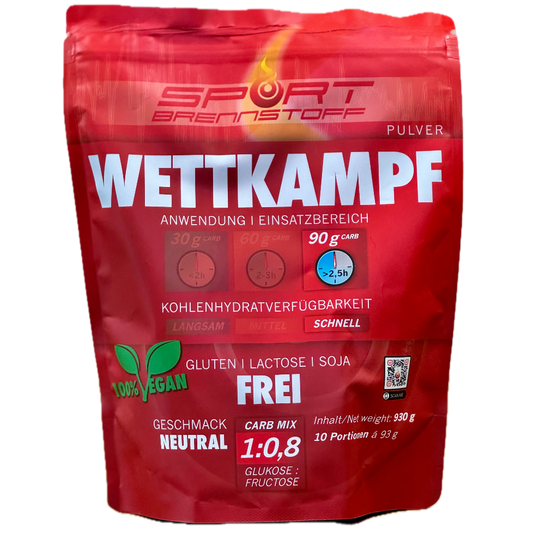
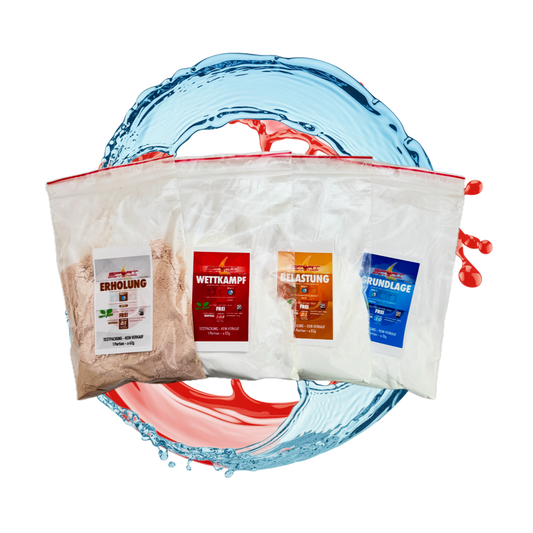
For basic training units, a homemade mix is perfectly adequate. Once you start pushing yourself in competitions, reliability matters more than price. A sports drink with an optimized glucose-fructose ratio, like the one offered by SportBrennstoff WETTKAMPF, can be scaled up to around 120 g of carbohydrates per hour. For beginners, the €5 sample pack is a sensible way to test tolerance before race day.
SportBrennstoff WETTKAMPF * 90g Carbs Drink Mix
WarningNever try a new drink for the first time in a competition. An unfamiliar product on race day is one of the most common causes of stomach problems in the final kilometers.
Frequently Asked Questions
What natural isotonic drinks are available?
Natural isotonic drinks can be made from water, fruit juice, and a pinch of table salt. A fruit juice spritzer mixed in a 1:3 ratio with water provides carbohydrates and electrolytes. For longer runs, mixtures with maltodextrin or glucose are suitable to keep blood sugar levels stable. Mineral water with sodium, potassium, and magnesium can also serve as a base. Ready-made natural sports drinks like those from SportBrennstoff are specially designed for endurance athletes and are tested for doping.
How can I make electrolytes for sports myself?
A simple electrolyte mixture can be made from 1 liter of water, 1/4 teaspoon of table salt (sodium), a pinch of potassium salt (e.g., from a pharmacy), and some magnesium citrate. Fruit juice provides flavor. For intense workouts lasting over 90 minutes, 300-600 mg of sodium per liter is advisable, depending on sweat loss. Those who sweat heavily can increase the salt content. Ready-made products often offer more precise dosing but are more expensive.
Why are natural sports drinks gentler on the stomach during long runs?
Natural sports drinks often contain fewer artificial additives and have a lower osmolality, which makes fluid absorption easier. A balanced carbohydrate concentration (6-8%) and a glucose-to-fructose ratio of 2:1 or 1:0.8 reduce the risk of gastrointestinal problems. In addition, natural ingredients such as maltodextrin and fruit juice can be gentler on the stomach than highly concentrated sugar mixtures.
Are homemade sports drinks isotonic?
Homemade sports drinks are isotonic if they contain about 6-8 g of carbohydrates per 100 ml and the electrolyte content resembles blood plasma. A recipe with 500 ml of water, 250 ml of fruit juice, and 1/4 teaspoon of salt achieves approximately this concentration. Testing with a refractometer is possible, but the rule of thumb is sufficient for home use. Those who want to be on the safe side should use ready-made isotonic drinks with tested osmolality.
The challenge remains: A drink must provide energy without straining the stomach, and do so for hours. This is exactly what SportBrennstoff developed its concept for: scientifically formulated products for every level of exertion, vegan, gentle on the stomach, and Kölner Liste® certified. Start with the €5 sample pack and find out which mixture suits your training.
Hat einen angenehmen neutralen Geschmack und geht direkt in die Beine! Nutze es in fast jedem Training für meinen Ironman 👍
Hallo Melanie, vielen Dank für deine tolle Rückmeldung! Schön, dass dir der neutrale Geschmack gefällt und dich unser Sportgetränk bei deinen Ironman-Trainings unterstützt. Wir wünschen dir weiterhin viel Erfolg und starke Beine! :-)
Das Wettkampf-Sportgetränk hat meine Erwartungen voll erfüllt
Das Wettkampf-Sportgetränk hat meine Erwartungen voll erfüllt. Über die gesamte Zeit des Radfahrens (Langdistanz) konnte ich das Getränk zuführen und kam ohne spürbares Energiedefizit in T2 an.
Angenehmer, nicht aufdringlicher oder vordergründiger Geschmack.
Hallo Jens, vielen Dank für deine tolle Rückmeldung! Schön, dass dich das Sportgetränk auf deiner Langdistanz zuverlässig versorgt hat und dir der angenehme, dezente Geschmack gefällt. Wir wünschen dir weiterhin viel Erfolg bei deinen Wettkämpfen! Ingolf
Mit diesen beiden Produkten kommt man wirklich in der Aufbauphase sehr gut klar
Mit diesen beiden Produkten kommt man wirklich in der Aufbauphase sehr gut klar.
Hallo Daniel, danke für dein tolles Feedback! Es freut uns sehr, dass das Basispaket dir in der Aufbauphase so gut hilft. Viel Erfolg weiterhin beim Training!
Tatsächlich ist das 6 Tage in der Woche beim Frühstück dabei
Tatsächlich ist das 6 Tage in der Woche beim Frühstück dabei. Innerhalb von einer halben Stunde ist meine Energie geladen und kann direkt ins Training einsteigen. Noch nie Probleme beide Verdauung
Hallo Daniel, vielen Dank für deine tolle Rückmeldung! Es freut uns sehr, dass das Sportgetränk dich so zuverlässig beim Frühstück und beim Start ins Training unterstützt – und du es gut verträgst. Weiterhin viel Freude beim Training! Ingolf
Super Preis Leistungsverhältnis, wir setzen es zum Muskelaufbau und zur Regeneration ein . Wir sind seit vier Monaten sehr erfolgreich mit diesem Produkten.
Hallo Daniel, vielen Dank für deine positive Rückmeldung! Es freut uns sehr zu hören, dass du mit unserem Recovery Shake so erfolgreich bist. Viel Erfolg weiterhin beim Muskelaufbau und der Regeneration! Dein Team von Sportbrennstoff