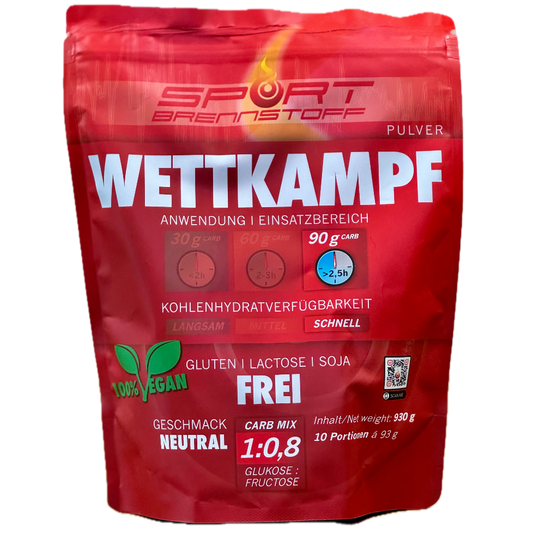
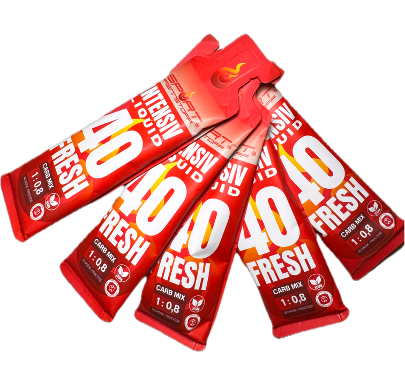
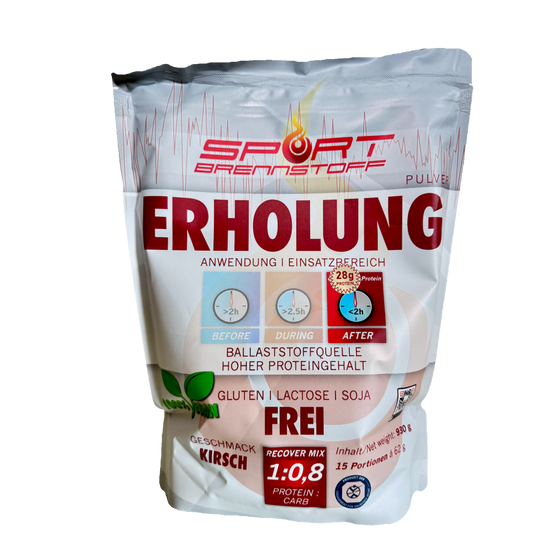
Why a sports drink with a glucose-to-fructose ratio of 1:0.8 protects your race pace – and why you should aim for up to 120 g of carbohydrates per hour on the bike and up to 80 g while running.
In a race, leg strength alone rarely decides the outcome. Over hours, what matters is whether your tank stays full. Those who refuel too late, too little, or with the wrong drink know the result: your stride shortens, your wattage drops, and your head goes blank. The good news is that modern sports drinks can deliver significantly more energy than just a few years ago – provided the carbohydrates are correctly formulated. The key is the ratio of glucose to fructose.
Two sugars, two doors into the body
Your gut absorbs glucose and fructose through different pathways. Glucose is transported into the bloodstream via the SGLT1 transporter, and this pathway is limited: it becomes saturated at around 60 g of glucose per hour. Anything beyond that stays in the gut, draws in water, and causes exactly the cramps, bloating, and nausea that every endurance athlete fears.
Fructose, on the other hand, uses its own transporter (GLUT5). By adding fructose, you open a second door and can significantly increase the total amount of usable carbohydrates – without overloading the glucose pathway. This is exactly the principle of "multiple transportable carbohydrates": the combination is oxidized better (meaning it is actually burned for energy) than the same amount of a single sugar, and it is noticeably easier on the stomach.
Why 1:0.8 and not the classic 2:1
For years, a ratio of 2:1 (glucose to fructose) was considered the gold standard. It works well – but mainly for moderate amounts up to around 90 g per hour. When it comes to really high absorption rates, current research shows a different picture: a ratio closer to 1:0.8 shifts the balance slightly in favor of fructose, thereby relieving the more quickly saturated glucose transporter. The result is higher oxidation rates, better tolerance, and the ability to reach the range of 100 g or more per hour in the first place.
In other words: 2:1 is the solid standard solution. 1:0.8 is the formula for everyone who really wants to refuel to the maximum during a race without sacrificing their stomach.
On the bike: up to 120 g of carbohydrates per hour
Cycling is the ideal discipline for a high carbohydrate intake. You sit steadily in the saddle, your upper body is hardly shaken, and blood flow to the gastrointestinal tract remains relatively stable. That is exactly why the body tolerates the largest amounts on the bike.
With a well-balanced 1:0.8 drink, up to 120 g of carbohydrates per hour is possible – a value that was considered impossible just a few years ago. This amount is a real advantage especially during long, intense efforts such as bike marathons, long triathlon distances, or hilly races, because your own glycogen stores are spared longer and performance remains stable until the final third.
Important: 120 g per hour is the upper limit for very well-trained and prepared athletes – not the mandatory value for everyone. Many already benefit enormously if they reliably stay in the range of 80 to 100 g.
While running: up to 80 g of carbohydrates per hour
When running, the rules of the game change. With every step, the gastrointestinal tract is shaken, the upper body works upright and under load, and blood flow to the digestive system drops more than on the bike. The result: the gut tolerates the same amounts worse, and the risk of side stitches, nausea, and "runner's diarrhea" increases.
Therefore, the sensible upper limit when running is around 80 g of carbohydrates per hour. Here too, the 1:0.8 ratio pays off: It ensures that these 80 g are utilized as completely as possible and leave as little as possible in the stomach. For marathons and half marathons, this is a range that noticeably relieves the stores without bringing the stomach to its knees.
Why the difference between 120 g and 80 g is so important
The difference is not a weakness of the drink, but a characteristic of your body. The same formula, the same optimized ratio – but the mechanical stress of running reduces tolerance. Those who ignore this distinction and try bike-amounts while running risk exactly the race withdrawal that good nutrition is actually supposed to prevent.
This is particularly relevant for triathletes: On the bike, you are allowed and should fill your tank (up to 120 g/h), because that is your window of opportunity to refuel. During the subsequent run, you consciously throttle back to around 80 g/h because the stomach reacts more sensitively now.
|
Cycling |
Running |
| Max. carbohydrates/hour |
up to 120 g |
up to 80 g |
| Main reason |
steady position, stable blood flow |
impact, poorer blood flow to the gut |
| Optimal ratio |
1:0.8 (glucose:fructose) |
1:0.8 (glucose:fructose) |
Training the gut – the underestimated training
No one tolerates high carbohydrate amounts at the push of a button. The gut can be trained like a muscle: Those who regularly work with the race drink and increasing amounts during training demonstrably improve absorption capacity and tolerance. "Gut training" therefore belongs in every serious competition plan.
Practical roadmap:
-
Start moderately. First practice with 60 g per hour and find your safe rhythm.
-
Increase weekly. Increase the amount in small steps, always with exactly the drink you use in the race.
-
Simulate the race. Test the target amount in training sessions that correspond to the race pace and race duration.
-
Nothing new on race day. What was never tested in training has no place in the race.
Timing: evenly instead of all at once
Distribute the carbohydrates evenly over the hour instead of dumping them in large portions. Small, regular sips – about every 10 to 15 minutes – keep blood sugar stable and do not overload the gut. Start early, even in the first 20 to 30 minutes, and do not wait for the first feeling of hunger. Those who only refuel when the tank is already empty will not catch up. And drink enough: liquid helps to move the carbohydrates further out of the stomach.
The most common mistakes
-
Too little, too late. The supply only starts when performance is already dropping.
-
Wrong ratio. A pure glucose drink hits the limit at 60 g/h – beyond that, stomach problems threaten instead of more energy.
-
Bike-amounts while running. Those who try 120 g/h while running risk their stomach.
-
Untested into the race. The gut was never accustomed to the target amount.
Conclusion
The right race nutrition is not a game of chance, but physiology. A sports drink with a glucose-to-fructose ratio of 1:0.8 optimally utilizes both absorption pathways of your body, thus allowing significantly higher energy amounts and being easier on the stomach. On the bike, you can take full advantage of this benefit with up to 120 g of carbohydrates per hour, while running leads the way through controlled 80 g per hour. Those who respect this distinction, train their gut, and refuel evenly keep performance high where races are decided: in the final hour.
This article is intended for adult endurance athletes. Very high carbohydrate amounts should be built up individually and tested in training.